

UN1070 Nitrous Oxide: What the Code Means for Shipping and Importing Cream Chargers
2026-11-13
Quick answer: UN1070 is the UN number for nitrous oxide (N2O) in transport. The U.S. Hazardous Materials Table (49 CFR 172.101) lists it as Class 2.2, a non-flammable gas, with a Class 5.1 oxidizer label for its secondary hazard.
- 8g cream chargers, small gas receptacles of 50 ml or less, can be declared under UN2037. Cylinders are declared under UN1070.
- Gases are not assigned a packing group (the I–III danger rating used for many liquids and solids), so the N2O entry on a dangerous goods declaration should show none.
- The UN number describes transport risk only. Food-grade status is checked against the E942 specification and the batch certificate of analysis.
This guide is written for importers, distributors and freight forwarders who ship or import cream chargers and N2O cylinders. It explains what the codes on cartons and paperwork mean, which rules apply by sea, road and air, and which documents to check before the goods arrive.
What Is UN1070 Nitrous Oxide?
A UN number is a four-digit code that the United Nations Committee of Experts on the Transport of Dangerous Goods assigns to a hazardous substance or group of articles. Carriers, port systems and emergency crews use it to identify cargo without relying on trade names. The nitrous oxide UN number is UN1070, and NOAA's CAMEO Chemicals database lists both "Nitrous oxide" and "Nitrous oxide, compressed" under it.
Buyers usually meet UN1070 in four places: the UN marking and diamond labels on the outer carton, the dangerous goods declaration issued by the shipper, Section 14 (transport information) of the safety data sheet, and the placards on a truck or freight container.
| Field | UN1070 at a glance |
|---|---|
| Proper shipping name | Nitrous oxide |
| Hazard class | Class 2.2 (non-flammable gas) |
| Labels | Class 2.2 and Class 5.1 |
| Packing group | None assigned |
| Air restriction | No limited quantity or consumer commodity shipments |
| Emergency response | ERG Guide 122 (oxidizing gases) |
The same entry applies whatever the gas is used for. UN1070 nitrous oxide is used for whipped cream, culinary foams and infusions in food service, for anesthesia and dental sedation in medicine, and as a process gas in semiconductor manufacturing. The grade of the gas is a separate question, covered further down.
Two related UN numbers often cause confusion on paperwork. UN2201 covers refrigerated liquid nitrous oxide, the form used for bulk cryogenic supply; U.S. rules forbid it on both passenger and cargo aircraft. UN2037 covers small gas receptacles and is the entry that matters for 8g chargers.
What Do Class 2.2 and the 5.1 Oxidizer Label Mean?
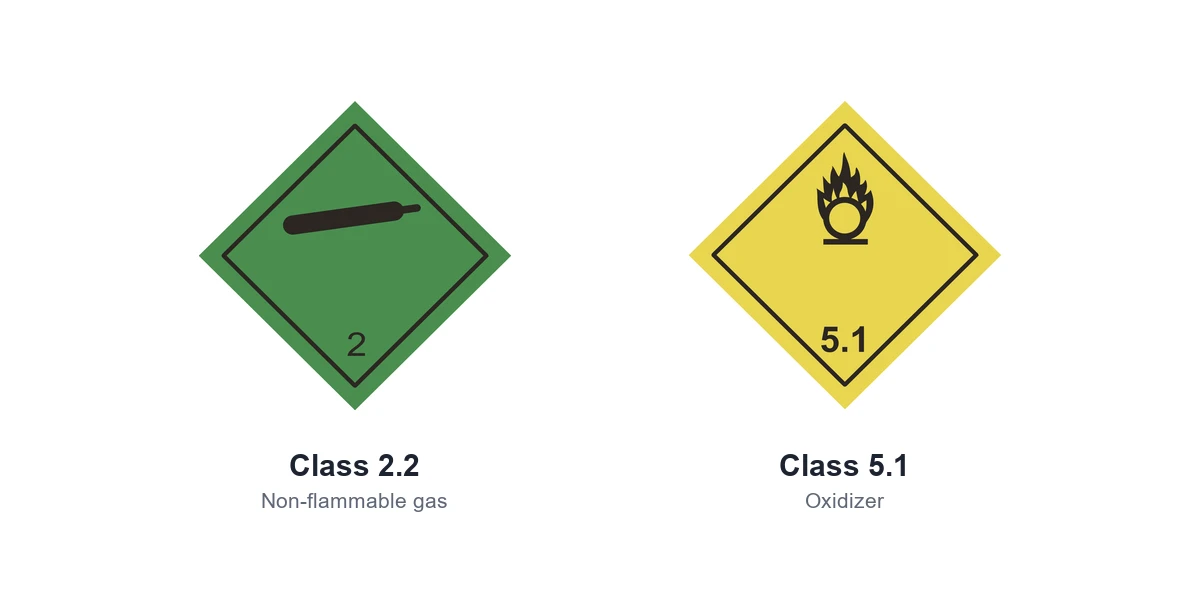
Class 2.2 covers compressed gases that are non-flammable and non-poisonous, such as nitrogen and carbon dioxide. What sets nitrous oxide apart is oxidation: N2O can feed and intensify a fire that starts in another material. For that reason it also carries the Class 5.1 oxidizer label as a secondary hazard.
| Label | What it signals | What it means in a warehouse |
|---|---|---|
| Class 2.2, green, gas cylinder symbol | Gas held under pressure; it does not burn | Keep cartons and cylinders away from heat sources; storage temperature should stay below 50°C (122°F) |
| Class 5.1, yellow, flame over circle | Oxidizer; it supports the burning of other materials | Store apart from flammable gases, fuels, oils and grease |
Which Placard Goes on a UN1070 Load?
Labels go on packages; placards go on the outside of the truck, rail car or container. Under U.S. rules (49 CFR 172.504), a UN1070 load takes the green NON-FLAMMABLE GAS placard, and an OXIDIZER placard for the 5.1 hazard is optional. For an importer, the practical step is to declare the load as UN1070 nitrous oxide when booking the truck, so placarding is arranged before pickup. In Europe (ADR) and at sea (IMDG Code), the freight forwarder confirms the placards for each leg.
UN1070 or UN2037: Which Number Applies to Cream Chargers?
U.S. rules list a separate UN2037 entry: "Receptacles, small, containing gas or gas cartridges (oxidizing), without release device, not refillable and not exceeding 1 L capacity." In plain terms, a container qualifies when it meets all three conditions:
- A capacity of 1 L or less
- No release device (a valve that vents gas when pressure rises)
- It cannot be refilled
An 8g cream charger is a single-use steel cartridge with a 13 ml capacity, sealed and without a valve, so it meets all three conditions. Champion Whip declares its 8g chargers under UN2037 and all of its cylinders, from 320g to 3000g, under UN1070. With any supplier, the number that applies to a shipment is the one on its dangerous goods declaration, and the forwarder books the cargo from that document.
Both entries are Class 2.2 and both require the 2.2 and 5.1 labels. The main difference for buyers is how much can go in one package by air:
| UN1070 Nitrous oxide | UN2037 Small receptacles (oxidizing) | |
|---|---|---|
| Typical product | Cylinders, 320g–3000g | 8g chargers |
| Class and labels | Class 2.2; labels 2.2 + 5.1 | Class 2.2; labels 2.2 + 5.1 |
| Max per package, passenger aircraft or passenger rail | 75 kg | 1 kg |
| Max per package, cargo aircraft only | 150 kg | 15 kg |
How Is UN1070 Nitrous Oxide Shipped by Sea, Road, and Air?
To work out how to ship cream chargers, start with the transport mode: it decides which rulebook applies. Each one treats N2O as dangerous goods; they differ in paperwork and limits.
| Mode | Rules | What the importer should expect |
|---|---|---|
| Ocean freight | IMDG Code | UN1070 cylinders: full container load (FCL) with a dangerous goods declaration and container placards. 8g chargers: container options follow their transport classification report |
| Road and rail, United States | U.S. DOT rules | Shipping papers with the UN number, proper shipping name and class; NON-FLAMMABLE GAS placard on the vehicle |
| Road, Europe | ADR | Dangerous goods transport document; vehicle equipment and driver training as ADR sets for Class 2 |
| Air cargo | ICAO Technical Instructions / IATA DGR; U.S. DOT rules for U.S. flights | Per-package limits by entry; no limited quantity or consumer commodity option |
| Passenger baggage | Airline and aviation authority rules | Filled chargers and cylinders are not accepted in carry-on or checked bags |
In our own ocean exports from China, 8g chargers can ship in a full container or be consolidated with the buyer's other general cargo in one container. UN1070 cylinders ship in full container loads (FCL) only.
Air freight carries the tightest limits. Under U.S. rules, a UN2037 package above 1 kg cannot fly on a passenger aircraft; it must travel on a cargo-only aircraft, up to 15 kg per package, and carry the CARGO AIRCRAFT ONLY label. Neither entry can use the limited quantity or consumer commodity options by air, and airlines apply their own acceptance policies to oxidizing gases, so the forwarder confirms carrier acceptance before booking. For most importers, this makes air freight a route for samples or urgent small lots, with regular stock moving by sea.
Passenger baggage is a separate matter: rules for carrying cream chargers on a flight are set by airlines and aviation authorities.
What Documents Should Come With a UN1070 or UN2037 Shipment?
Before the cargo arrives, an importer should hold a matching set of documents. Discrepancies are cheaper to fix while the goods are still at the origin port.
- Dangerous goods declaration. For cylinders the description reads "UN1070, Nitrous oxide, 2.2 (5.1)", followed by the quantity.
- Safety data sheet. Section 14 should give the same UN number and proper shipping name as the declaration.
- Batch certificate of analysis. Purity and impurity results, with batch numbers that match the numbers printed on the cartons.
- Commercial invoice and packing list. Product descriptions, piece counts and gross weights consistent with the declaration. Because the cream chargers HS code depends on the destination country's tariff schedule, have your customs broker confirm the classification before the first order ships.
- Carton markings. The UN number and proper shipping name next to the 2.2 and 5.1 labels on each outer carton.
Three red flags on the paperwork
- A packing group on the N2O line. U.S. rules assign no packing group to UN1070 or UN2037. "PG II" or "PG III" next to nitrous oxide usually means the declaration was filled in from a template for another product.
- Numbers that do not match. The UN number on the declaration, in SDS Section 14 and on the cartons should be the same.
- A 2.2 label without the 5.1 label. Both entries require both labels. A carton showing only the green 2.2 diamond is labeled incompletely.
Does UN1070 Mean the Gas Is Food Grade?
No. UN1070 describes the transport hazard of nitrous oxide and applies equally to medical, industrial and culinary gas. A cylinder can carry a correct UN1070 marking and contain gas that has never been tested against a food specification. Food suitability is answered by food additive rules and batch testing.
| Question | Where the answer comes from |
|---|---|
| How must the gas be packed, labeled and carried? | UN1070 or UN2037 entry; SDS Section 14 |
| Is the gas permitted in food? | Food additive listing, such as E942 in the EU |
| What purity does this batch have? | Batch certificate of analysis (CoA) |
The E942 specification sets the legal minimum for food use in the EU, and commercial culinary gas is normally filled above it. N2O purity grades of 99.5%, 99.9% and 99.95% also differ in how the gas performs in a dispenser. Champion Whip fills food-grade N2O at 99.95% purity as its standard specification and tests 1 in 100 units for purity and pressure.
Sourcing UN1070 Stock From Champion Whip
Champion Whip keeps 8g chargers and 320g, 640g, 1364g, 2000g and 3000g cylinders in warehouses in Los Angeles, New York, Germany and Belgium. Buying from local stock means the international dangerous goods leg is already complete, and the order moves only by domestic carriage. U.S. orders typically arrive 5–7 business days after payment, and buyers can also collect from the U.S. and European warehouses.
Orders start at one pallet: 32,400 pieces for 8g chargers or 504 units for 640g cylinders, with sizes and flavors mixable in one order. Gas is filled at 99.95% purity as standard, and 1 in 100 units is tested for purity and pressure. Send sizes and quantities through the cream chargers wholesale page for a quote, answered within 4 hours.
FAQ
What is the UN number for nitrous oxide?
What hazard class is nitrous oxide?
What is UN1070 nitrous oxide used for?
Is nitrous oxide considered hazardous?
Do 8g cream chargers ship as UN1070?
Does nitrous oxide have a packing group?
Can cream chargers be shipped by air freight?

Verhoog uw Creaties met Champion Whip
Ontdek onze premium slagroomopladers — ontworpen voor perfectionisten.
View our Products


