

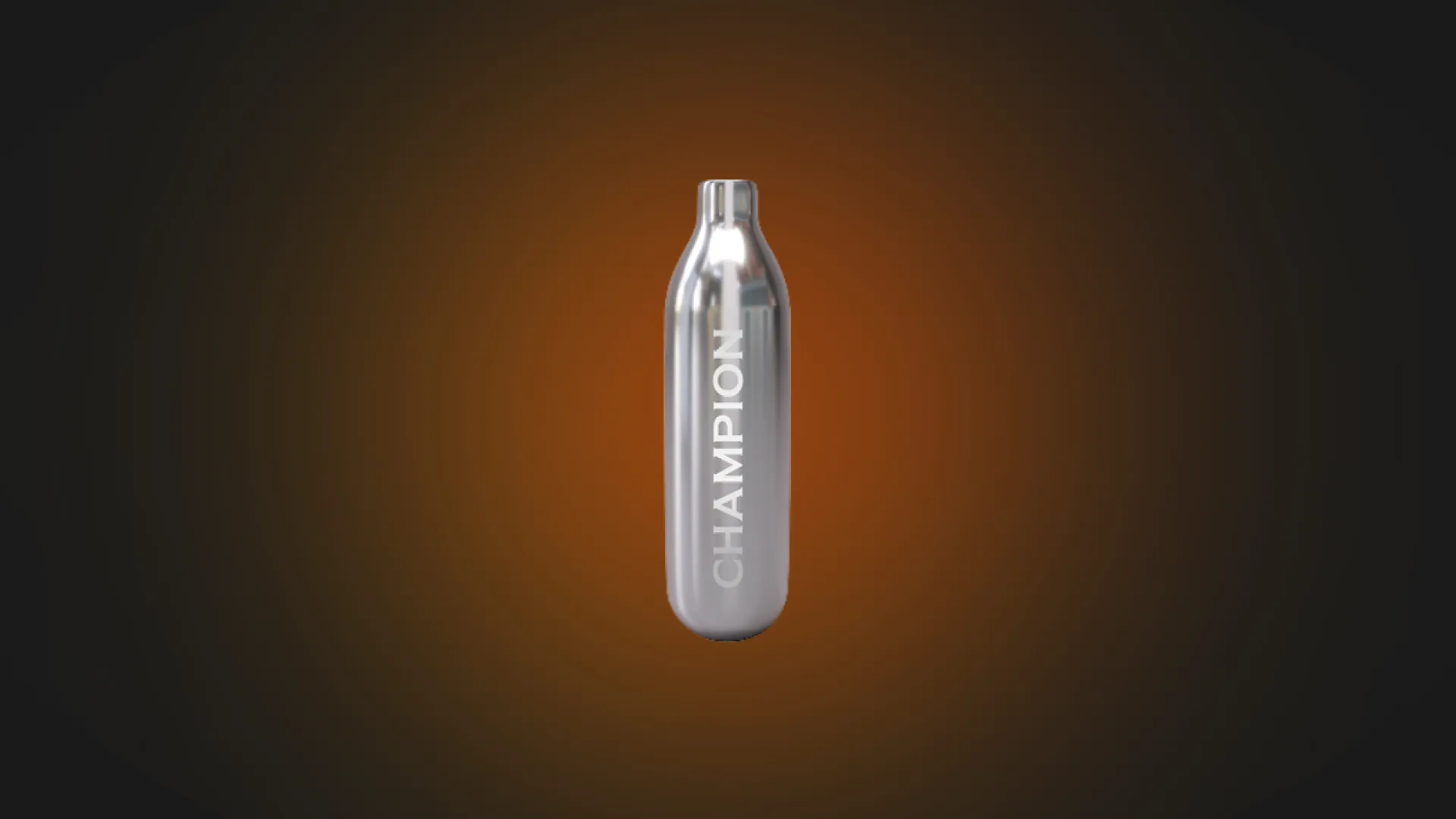
N2O Purity Explained: 99.5% vs 99.9% vs 99.95%
2026-07-06
"Food-grade" on a cream charger box tells you the gas is legal for food contact. It doesn't tell you how clean it actually is. Purity numbers like 99.5%, 99.9%, and 99.95% look almost identical on a spec sheet, but the gap between them is where cream quality, shelf life, and equipment wear are decided. For a café owner buying a pallet of chargers, or a distributor vetting a new supplier, that gap is the whole decision.
We manufacture food-grade N2O and fill cream chargers factory-direct, so we deal with what those decimal points mean every day. This guide breaks down the three purity tiers you'll see on the market, what actually sits in the fraction of a percent that isn't nitrous oxide, how purity shows up in the finished cream, and exactly what documentation to demand before you commit to a volume order.
The Three Purity Grades You'll See on the Market
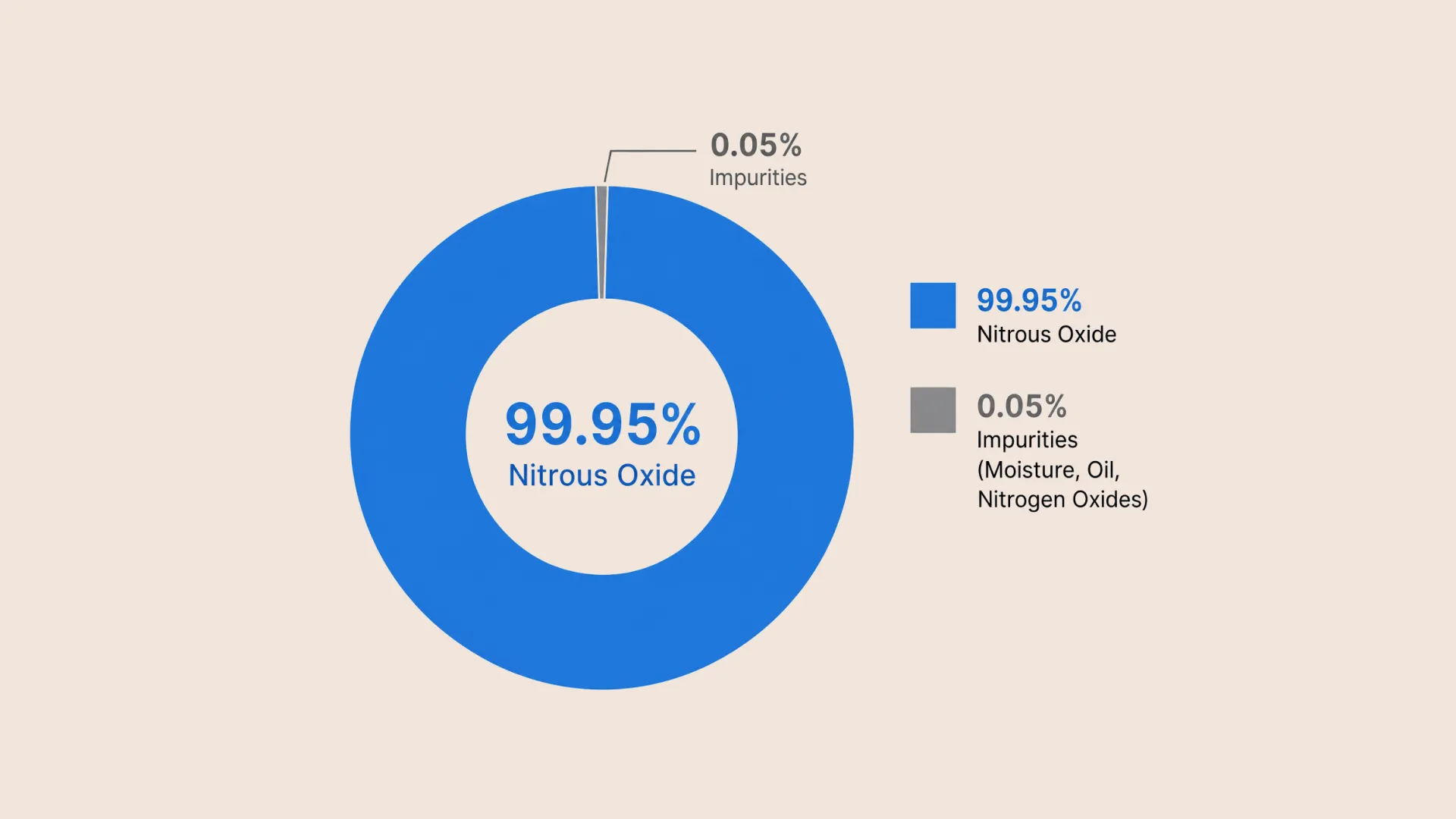
Purity is the share of the contents that is actual nitrous oxide, measured by volume. The rest is a small residual of other gases and moisture. Food-grade N2O sold for cream chargers falls into three practical tiers.
| Grade | Purity | Typical classification | What it means for you |
|---|---|---|---|
| Entry food-grade | ≥ 99.5% N2O | Meets the common E942 minimum | Legal and safe, but the widest impurity window — up to 0.5% other content |
| Standard premium | ≥ 99.9% N2O | Common on quality brands; also the medical floor | Reliable, consistent performance for most kitchens |
| Top-tier food-grade | ≥ 99.95% N2O | Premium specification, few suppliers hit it | Tightest impurity control, most consistent cream and longest equipment life |
Two points cut through the marketing noise. First, the legal minimum is not the same everywhere. Under the EU's E942 framework the accepted floor is commonly cited around 99.5% N2O, and several national food-additive standards land in the same range, while medical-grade N2O is held to 99.9% or higher. Some suppliers treat 99.9% as the practical food-grade floor. Second, most cream-charger gas on the open market sits between 99.5% and 99.9%. The 99.95% tier is a premium claim that only a handful of manufacturers actually reach and can prove on paper.
What Lives in the Missing Fraction
The headline number is only half the story. What matters just as much is what fills the 0.05% to 0.5% that isn't nitrous oxide. This is where cheap gas and clean gas separate, and none of it is visible in the cylinder.
Trace moisture
Water vapor is the most common residual. Moisture varies the way N2O dissolves into cream, so you get stiff peaks one batch and loose, unstable foam the next. Over time it also promotes corrosion on the inside of the steel cylinder. For a kitchen that needs identical results every service, inconsistent moisture is a daily headache.
Oil residue
N2O is compressed during filling, and worn compressor seals can leave a faint oil film in the gas stream. That film carries into the cream as an off-taste and shortens the working life of the dispenser's silicone gaskets. Clean production lines with proper filtration keep this out; cut-rate ones don't always.
Higher nitrogen oxides and residual ammonia
Food-grade N2O is produced by the controlled thermal decomposition of ammonium nitrate. The raw gas contains higher oxides of nitrogen (NO and NO2) and residual ammonia that must be scrubbed out in a multi-stage purification process before filling. If that scrubbing is incomplete, the gas carries a sharp odor and can taint delicate preparations.
The impurities that matter in food-grade N2O are trace moisture, oil residue from compressor seals, and higher oxides of nitrogen left over from production. A 99.5% gas can legally carry up to 0.5% of these residuals; a 99.95% gas holds them to 0.05%. That tenfold difference in impurity headroom is the real reason the purity tiers exist.
Does Purity Actually Change Your Whipped Cream?
Yes, in three ways you can measure in a working kitchen.
Flavor neutrality. Clean N2O is odorless and flavor-neutral, which is exactly what a whipped cream, an espuma, or an infused foam needs — a carrier that disappears into the food. Trace impurities show up as a faint metallic or chemical note that a good palate will catch, especially in lightly flavored or savory preparations.
Foam consistency. Moisture and composition variation change how the gas saturates the cream's fat. Higher, more consistent purity gives you the same texture batch after batch. A busy patisserie or coffee bar feels this immediately, because inconsistent foam means remakes and waste.
Shelf life and equipment. Moisture and nitrogen oxides corrode the cylinder and degrade dispenser seals over time. Clean gas protects your equipment, and because N2O is bacteriostatic, a well-charged canister of cream keeps in the fridge for up to two weeks rather than a day.
The Standards Behind Food-Grade N2O
Purity claims only mean something against a recognized standard. For cream chargers, food-grade is the only legally usable type, and four frameworks define it across the main markets.
| Standard | Region | What it covers |
|---|---|---|
| INS 942 (FAO/WHO) | International | The international food-additive code for nitrous oxide, set by the Joint FAO/WHO Expert Committee on Food Additives |
| FDA 21 CFR 184.1545 | United States | Classifies N2O as GRAS (Generally Recognized As Safe) for food use |
| E942 / Reg (EC) No 1333/2008 | European Union | Authorizes N2O as a food additive propellant with defined purity and contaminant limits |
| GB 1886.350-2021 | China | National food-additive standard for N2O, in effect since March 2022 |
Industrial-grade N2O looks identical in a tank but is produced and stored to different rules. It can carry additives, heavy metals, oil, or moisture that make it unsafe for food contact. Using it in a commercial kitchen is a food-law violation in most markets, regardless of how clean the label looks.
How Purity Is Actually Tested
Purity is verified in a lab, not by eye or by smell. The standard method is gas chromatography, which separates the sample into its component gases and measures each one, confirming the N2O share and flagging contaminants. For trace-level residuals, headspace gas chromatography–mass spectrometry (HS-GC-MS) quantifies impurities down to very low concentrations. The numbers these tests produce are what a Certificate of Analysis reports for a given batch.
Sensory checks — releasing a little gas into a clean glass to smell for odor — can catch a badly contaminated batch, but they are a rough backstop, not proof. A lab report tied to your specific lot is the only reliable evidence.
The B2B Verification Checklist
Everyone prints "food-grade" and "high-purity" on the box. The number on its own means nothing without documentation. Before you place a volume order, confirm the supplier can provide all of the following:
- Certificate of Analysis (CoA). Batch-specific, showing purity, moisture, and contaminant limits — issued by an accredited third-party laboratory, not just the manufacturer's internal QA.
- Safety Data Sheet (SDS). The physical and chemical properties and handling guidance for the gas.
- Lot and batch traceability. Every shipment should carry a lot number that cross-references to its CoA. This is essential for HACCP audits.
- Compliance documentation. Proof of alignment with the relevant standard for your market — INS 942, FDA 21 CFR 184.1545, E942, or GB 1886.350.
- Third-party certifications. SGS, ISO, CE, and HACCP or FSSC 22000 marks that verify the wider quality system, not just one test.
The warning signs are just as clear: "trust us, it's food-grade" with no paperwork, certificates that are generic or out of date, or a purity figure that every competitor on the page happens to print. If the documentation is missing or vague, assume the gas inside the cylinder isn't what the label claims.
How to Request a Certificate of Analysis
Getting a CoA is straightforward when you ask correctly. Request the batch-specific certificate that matches the lot number printed on your shipment, not a generic sample document. Confirm the issuing laboratory is an accredited third party. Check that it reports the actual N2O purity plus limits for moisture and key contaminants, and that the batch matches what the supplier promised. Keep the certificate on file so it's ready for any food-safety audit or customs check. A supplier who can turn this around quickly is one worth building a relationship with.
The Bottom Line
Between 99.5%, 99.9%, and 99.95% the molecule is the same — what changes is how much room the spec leaves for the impurities that hurt flavor, consistency, and equipment life. Entry-grade gas is legal and safe when properly certified; premium 99.95% gas simply gives you a tighter, more predictable result and better protection for your dispensers. For a business, the decision isn't only the number on the box. It's whether the supplier can prove it with a batch-specific, third-party Certificate of Analysis.
At Champion Whip we fill every charger with 99.95% food-grade N2O and back each batch with third-party CoA, SDS, and full lot traceability. If you're sourcing for a kitchen or for resale, browse our 8g cream charger range or the full product catalog, and reach out through our wholesale or OEM and custom programs for volume pricing and private-label options.
FAQ
What is the minimum purity for food-grade nitrous oxide?
The commonly cited minimum for food-grade N2O is around 99.5% under the EU's E942 framework, and several national food-additive standards sit in the same range. Some suppliers treat 99.9% as their practical floor. Anything sold for cream chargers must meet the food-additive standard for your market — INS 942, FDA 21 CFR 184.1545, E942, or GB 1886.350 — and be backed by certification. Industrial-grade N2O, even at a similar number, is not legal for food contact.
What's the difference between 99.5%, 99.9%, and 99.95% N2O?
The molecule is identical; the difference is the size of the impurity window. A 99.5% gas can legally contain up to 0.5% of other content — trace moisture, oil residue, and higher nitrogen oxides. A 99.9% gas limits that to 0.1%, and a 99.95% gas to 0.05%. That tenfold difference between the top and bottom tier is what affects flavor neutrality, foam consistency, and how gently the gas treats your cylinder and dispenser seals over time.
Does higher N2O purity make better whipped cream?
In practice, yes — cleaner gas gives more consistent results. Higher purity means fewer trace impurities to introduce off-flavors, so espumas, infused creams, and lightly flavored foams taste cleaner. It also means more consistent foam texture batch to batch, because moisture and composition variation is tighter. The molecule doing the whipping is the same at every grade, but the consistency and neutrality improve as purity rises.
Is medical-grade N2O better than food-grade for cream chargers?
Not for culinary use. Medical-grade N2O is held to 99.9% or higher and is regulated under pharmaceutical GMP rules, but that's aimed at sterility and patient safety, not cream quality. A top-tier 99.95% food-grade gas already delivers the purity a kitchen needs. What matters for cream chargers is food-grade certification and a clean impurity profile, not a medical label — and medical gas is not sold or priced for foodservice use.
How is nitrous oxide purity tested?
In a laboratory. The standard method is gas chromatography, which separates a sample into its component gases and measures the N2O share while detecting contaminants. For trace-level residuals, headspace gas chromatography–mass spectrometry (HS-GC-MS) quantifies impurities down to very low concentrations. These lab results are what a Certificate of Analysis reports. Sensory smell tests can flag a badly contaminated batch but are not proof of purity.
What is a Certificate of Analysis and why does it matter?
A Certificate of Analysis (CoA) is a batch-specific document confirming the N2O purity, moisture content, and contaminant limits for a particular production lot. It should be issued by an accredited third-party laboratory rather than the manufacturer's internal QA alone. The CoA is your evidence that the gas matches the label, and it's essential for HACCP compliance and food-safety audits. Without a batch-matched CoA, a purity claim is just a number on a box.
How can I verify a supplier's purity claims before buying in bulk?
Ask for documentation and check that it's specific to your shipment. Request a batch-specific CoA whose lot number matches the cylinders you received, confirm the issuing lab is an accredited third party, and verify the report lists purity plus moisture and contaminant limits. Look for supporting SDS, lot traceability, and third-party marks like SGS, ISO, CE, or HACCP. Treat generic certificates, out-of-date paperwork, or "trust us" claims as red flags.

Elevate Your Creations with
Champion Whip
Explore our premium whipped cream chargers – designed for perfectionists.
View our Products


