

E942 Food Additive: EU Nitrous Oxide Rules, Purity Specs and Buyer Verification
2026-10-09
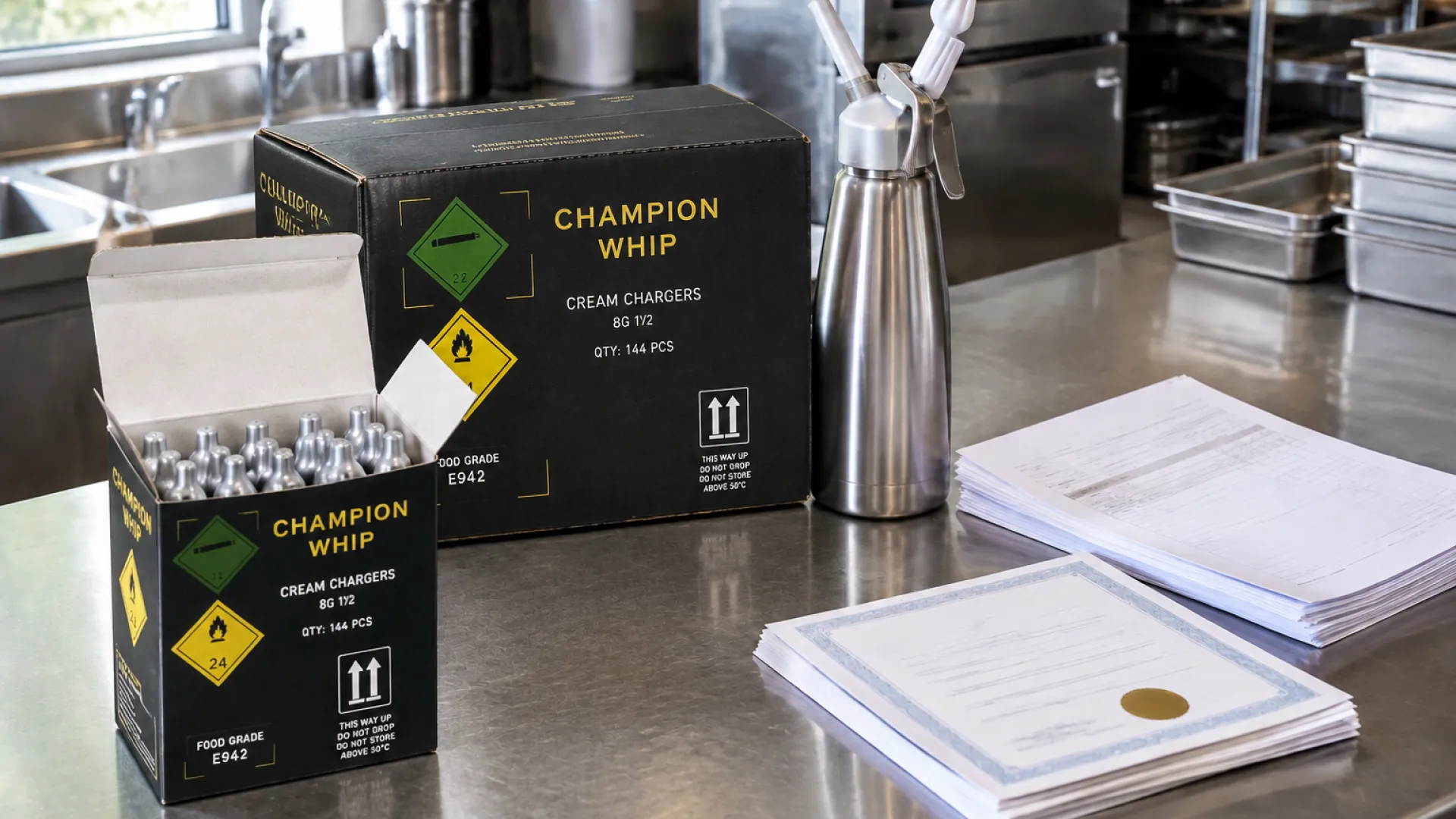
E942 is the European Union's food additive code for nitrous oxide (N2O). Within the EU framework, it is authorized as a propellant and packaging gas, and it is the designation that appears on cream charger packaging, certificates of analysis, and supplier specifications. For a buyer, seeing E942 on a document answers three questions at once: the gas is legally approved for food use in the EU, it must meet a defined purity specification, and it belongs in your compliance records. This guide explains what the code means, which regulations define it, and how to verify that a supplier's product actually meets the standard.
What Is E942? The EU Food Additive Code for Nitrous Oxide
The European Union assigns an E number to every additive authorized for food use under Regulation (EC) No 1333/2008. Each substance on this Union List has passed a safety evaluation by the European Food Safety Authority (EFSA) and is approved for defined food categories and functions.
E942 covers nitrous oxide in two functional classes. As a propellant, it expels liquid from a pressurized container — aerosol whipped cream cans work this way, and the same physics drives whipped cream dispensers used with chargers or cylinders: N2O dissolves into the fat phase of cream under pressure and expands on release, forming a stable foam. As a packaging gas, it fills the headspace of a package to protect the product. Both functions rely on the same properties: high fat solubility, neutral taste, and inert behavior in the finished food.
One naming caution for procurement teams: the string "E942" also appears outside the food industry, for example as a product name for a cement-based waterproofing material. It has no connection to the food additive code. Inside the additive system, the neighboring codes are different gases — E941 is nitrogen, E938 is argon — so a specification that says only "E94x gas" is not precise enough for a purchase order.
Which EU Regulations Govern E942? 1333/2008 and 231/2012
Two regulations define E942, and buyers should know what each one does. Regulation (EC) No 1333/2008 is the authorization layer: it places nitrous oxide on the Union List as E942, in the propellant and packaging gas categories, with use levels following good manufacturing practice (quantum satis) rather than a fixed numerical cap.
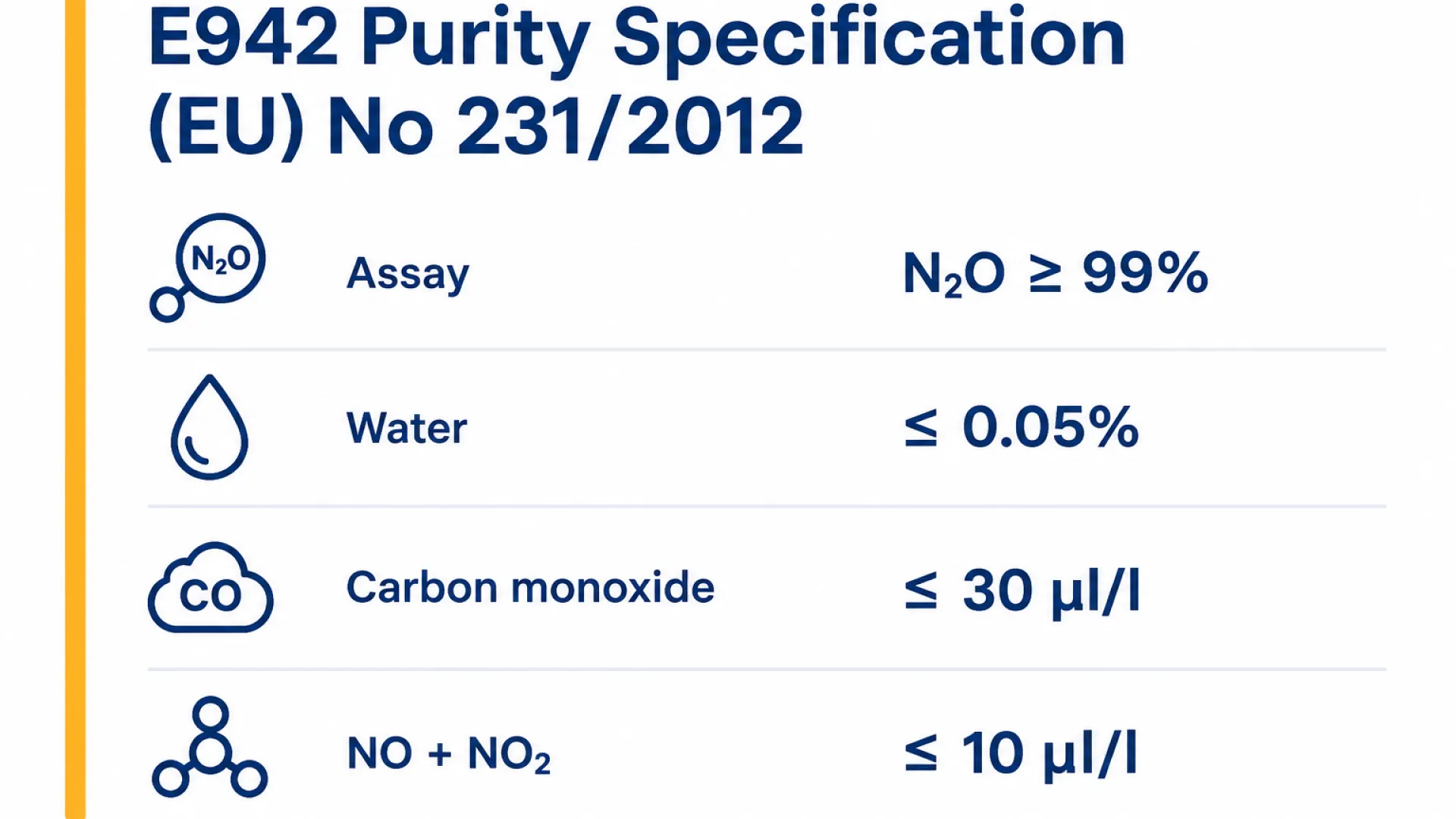
Commission Regulation (EU) No 231/2012 is the specification layer. It sets the purity criteria that nitrous oxide must meet to be sold as E942:
| E942 specification (EU) No 231/2012 | Limit |
|---|---|
| Assay (N2O content) | Not less than 99% |
| Water | Not more than 0.05% |
| Carbon monoxide | Not more than 30 µl/l |
| Nitric oxide and nitrogen dioxide | Not more than 10 µl/l |
Start with the legal floor: the EU requires E942 gas to assay at 99% purity or higher. Some suppliers market 99.5% as "the E942 requirement," but the regulation itself stops at 99%; grades above that are commercial specifications chosen by each supplier. Professional culinary gas is commonly supplied at 99.9% or higher, and Champion Whip ships 99.95% as the standard specification across the entire range. Purity above the floor mainly means less moisture and fewer trace nitrogen oxides — the impurities behind inconsistent foam and off-flavors in daily kitchen use. When a quote says "E942 compliant," ask for the assay the supplier actually ships.
Food-Grade E942 vs Industrial N2O: What's the Difference?
Nitrous oxide sold for welding, automotive, or other technical uses is a different product in regulatory terms, even though the molecule is identical. The differences that matter to a food business:
| Food-grade E942 | Industrial N2O | |
|---|---|---|
| Regulatory status | Authorized food additive under the EU framework | Technical specification; no food-use authorization |
| Purity and impurities | 231/2012 limits on water, CO, and nitrogen oxides; commercial grades reach 99.9–99.95% | Set by the technical application; moisture and lubricant residues possible |
| Documentation | Batch Certificate of Analysis, food-safety conformity, lot traceability | Safety and transport documents only |
| Packaging | Cylinders and chargers produced for food contact, with pressure-test evidence | Industrial cylinders; no food-contact controls |
The kitchen consequences are practical. Excess moisture in the gas changes how cream whips from batch to batch. Trace contaminants carry flavor into delicate preparations like espumas and infused creams. And in an audit, "the gas was cheaper from an industrial supplier" is not a defense — using non-food-grade gas in food production violates EU food law. For the mechanics of how food-grade N2O behaves inside a dispenser, see how food-grade N2O works in a dispenser.
E942 vs UN1070: Why the Same Cylinder Carries Two Codes
Buyers regularly see both codes on the same shipment and assume one implies the other. They describe different things. E942 identifies nitrous oxide as a food additive — it governs what the gas is allowed to touch. UN1070 is the dangerous-goods identifier for nitrous oxide in transport — it governs how the cylinder moves: Class 2.2 non-flammable gas labeling, ADR paperwork for road freight in Europe, IATA rules for air.
The two codes come with different documents. A Certificate of Analysis speaks to batch purity against the E942 specification. A Safety Data Sheet and transport declaration speak to handling and carriage. A cylinder can carry a valid UN1070 marking and still hold gas that has never been tested to food specifications, so the transport code is never proof of food-grade conformity. When you qualify a supplier, ask for both sets of documents and check that the batch numbers on them match.
How Can Buyers Verify E942 Compliance? A Document Checklist
Verification takes four checks, and all four should be routine before a new supplier's product reaches your kitchen or your customers:
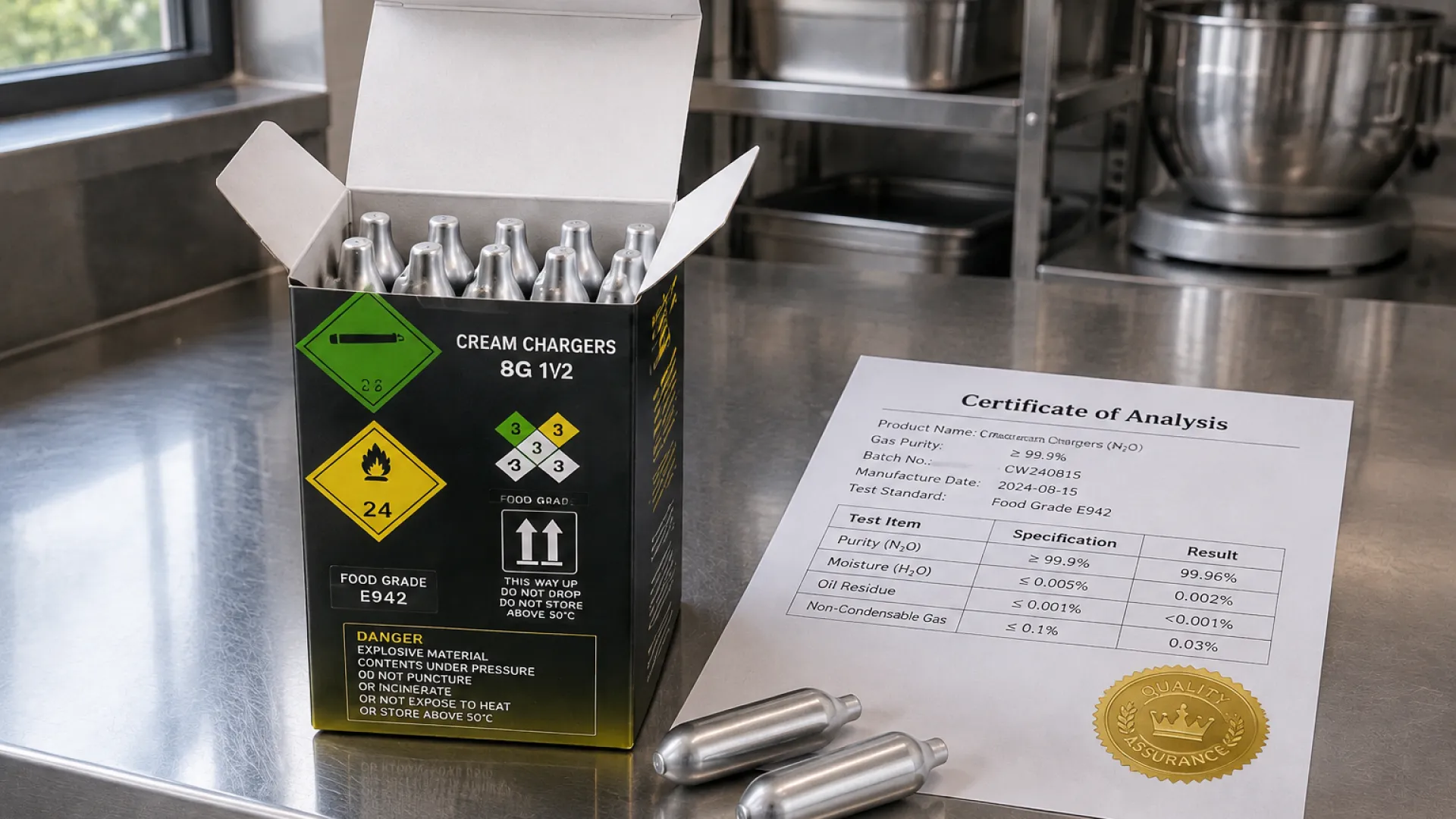
- E942 designation on the packaging or specification sheet. The regulated designation should appear explicitly, as "E942" or "nitrous oxide E942." A label that says only "N2O" or "food grade" is marketing language, not a regulatory statement.
- Lot or batch number. Every shipment should carry a batch identifier that can be traced to a specific production run. This is what makes HACCP records and recall procedures possible.
- Certificate of Analysis, checked against four numbers. A batch CoA should state the assay, water, carbon monoxide, and nitrogen oxide results. Compare them against the 231/2012 limits in the table above: assay at or above 99% (and ideally far above it), water at or below 0.05%, CO at or below 30 µl/l, NOx at or below 10 µl/l. A CoA without these four lines, or one that is not batch-specific, does not do the job.
- Cylinder certification. Chargers and cylinders should carry pressure-test evidence and the transport markings required in your market.
Suppliers should make this easy. At Champion Whip, every batch ships with a Certificate of Analysis, production runs under FDA, CE, FSSC 22000 and SGS-audited standards, and 1 in every 100 units is pulled for purity and pressure testing before release. If a supplier cannot produce a batch CoA on request, treat that as a qualification failure and move on. For documented B2B supply with batch paperwork on every order, see our wholesale cream charger program.
Is E942 Halal, Kosher and Allergen-Free?
Nitrous oxide is a synthetic inorganic gas. It contains no animal-derived ingredients, no gluten, and no substances on the major allergen lists, and it is generally classified as halal and suitable for vegan products by additive references. That said, buyers supplying certified halal or kosher programs should request the supplier's certification documentation rather than rely on the chemistry alone — certification is about audited production practice, and a statement on a website is not a certificate.
E942 Outside the EU: INS 942, FDA Status and National Restrictions
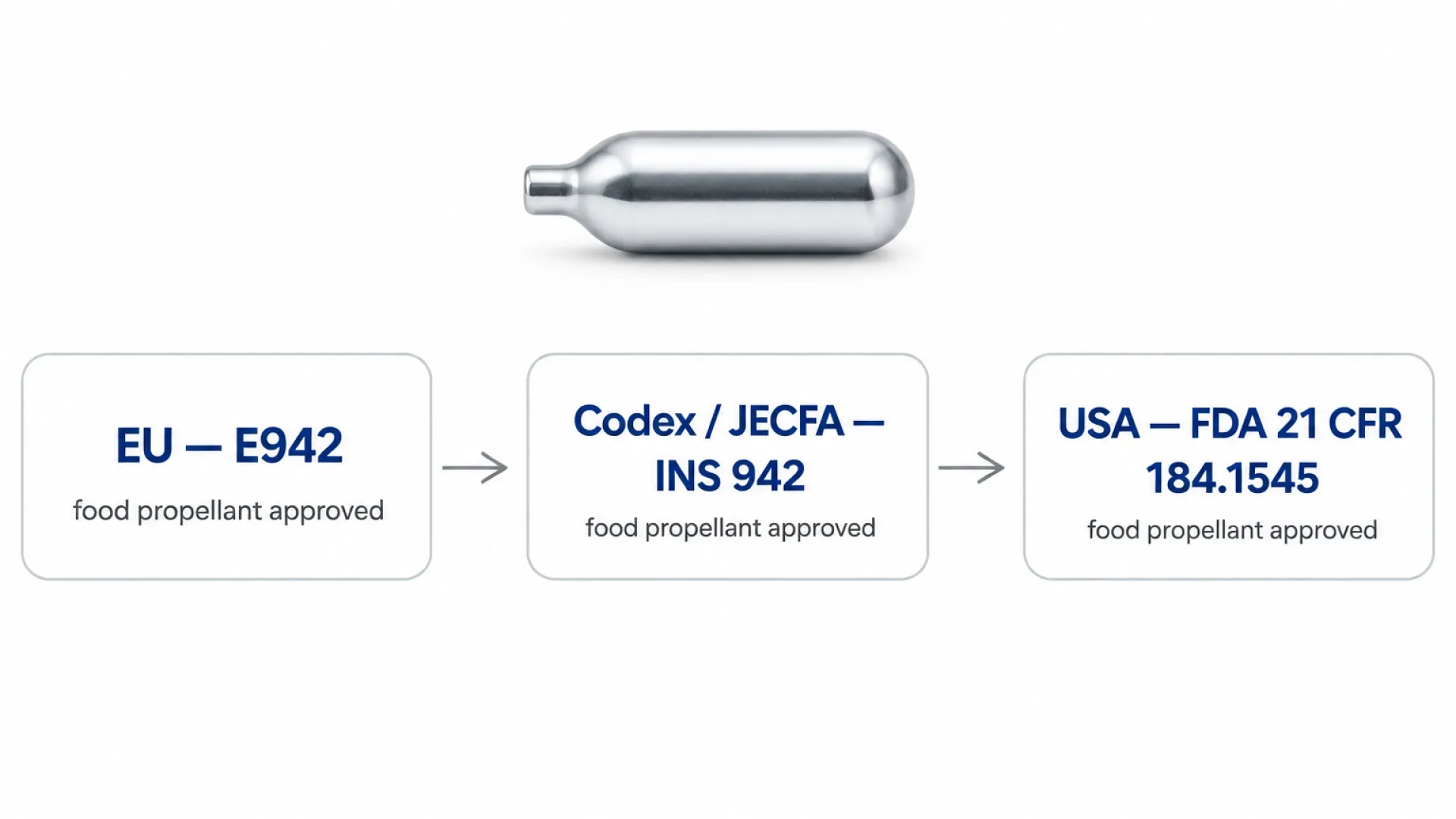
E942 is an EU designation, but the same gas is regulated under parallel systems elsewhere, and international buyers will meet all three:
| System | Code | What it does |
|---|---|---|
| European Union | E942 (Reg. 1333/2008 + 231/2012) | Food additive authorization and purity specification |
| Codex / JECFA | INS 942 | International additive number used in global trade documents; comparable purity criteria |
| United States | FDA 21 CFR 184.1545 | Affirms nitrous oxide as GRAS for use as a propellant and aerating agent in food |
The three systems converge on the same practical position: nitrous oxide at roughly 99% assay or better, with tight limits on moisture and nitrogen oxides, is accepted for food propellant use. A supplier shipping between these markets should be able to map its specification to all three codes on one document set.
What has changed in recent years is retail access, not food use. The Netherlands restricted general nitrous oxide sales in 2023, France tightened sales rules to protect minors, and the UK made possession for non-food purposes an offense in 2023 — while wholesale supply of food-grade product to food businesses remains lawful under professional-use provisions in each case. The United States is moving in the same direction state by state; our state-by-state guide to U.S. nitrous oxide laws tracks that landscape. For buyers, the direction of travel is consistent: culinary channels stay open, and documentation is what keeps them open.
We manufacture food-grade N2O chargers and cylinders from 8g to 3000g at 99.95% purity, with a batch Certificate of Analysis on every order and stock in Los Angeles, New York, Germany, and Belgium for short lead times. If your supply planning depends on documented E942-compliant gas, our wholesale program supports accounts across North America and Europe.
Additive regulations and retail restrictions continue to evolve. This guide reflects the regulatory landscape as of October 2026; confirm current requirements with your local authority or legal counsel before making compliance decisions.
FAQ
Is E942 food additive safe?
Yes, when used as intended. E942 passed EFSA safety evaluation before authorization under Regulation (EC) No 1333/2008, and the trace amounts of gas remaining in food after proper use are considered negligible. Food businesses should still source only gas that meets the EU purity specification, because that is where contamination risk is actually controlled.
What is E942 used for in food?
E942 has two authorized functions. As a propellant, it drives aerosol whipped cream cans and whipped cream dispensers charged with N2O cartridges or cylinders. As a packaging gas, it fills the headspace of food packages to protect the product. In professional kitchens it also enables culinary foams such as espumas.
Is E942 halal?
Nitrous oxide is a synthetic inorganic gas with no animal-derived ingredients, and additive references generally classify it as halal, vegan, gluten-free, and free of major allergens. For certified halal or kosher supply programs, request the supplier's certification documentation rather than relying on the chemistry alone.
What purity does the EU require for E942?
Commission Regulation (EU) No 231/2012 sets an assay of not less than 99% N2O, with water not exceeding 0.05%, carbon monoxide not exceeding 30 µl/l, and nitric oxide plus nitrogen dioxide not exceeding 10 µl/l. Commercial culinary gas is usually supplied well above the legal floor, at 99.9% to 99.95%.
Is E942 the same as UN1070?
No. E942 is the EU food additive code for nitrous oxide and governs food use. UN1070 is the dangerous-goods identifier for transporting nitrous oxide and governs freight classification. A valid UN1070 marking says nothing about food-grade conformity, so buyers should verify both document sets separately.
Does E942 have to appear on ingredient labels?
Yes. A finished food that contains nitrous oxide must declare it in the ingredient list, either as "E942" or as "nitrous oxide." There are no additional allergen or intolerance labelling requirements attached to this additive.
How much does E942 nitrous oxide cost?
Price depends on format, purity grade, and order volume rather than on the E942 designation itself. Single-use 8g chargers, mid-size cylinders, and large tanks price very differently per gram of gas, and bulk or wholesale orders reduce unit cost substantially. The meaningful comparison is cost per gram of food-grade gas with batch documentation included, not the sticker price of the container.


Elevate Your Creations with
Champion Whip
Explore our premium whipped cream chargers – designed for perfectionists.
View our Products


