

Nitrous Oxide Laws by State: 2026 Guide for Food Businesses and Wholesale Buyers
2026-09-28
Nitrous oxide laws by state form a patchwork in the U.S.: food-grade N2O is legal at the federal level, while each state sets its own rules on who can sell it, who can buy it, and at what age. For restaurants, cafés, bakeries, and the distributors who supply them, the practical question in 2026 is which rules apply in the states where they operate.
This guide maps the landscape as of September 2026: the federal baseline, the four regulatory models states use, a state-by-state reference table, the new laws passed in 2025–2026, and a compliance checklist for culinary buyers and sellers.
Is Nitrous Oxide Legal in the United States?
Yes. Nitrous oxide is legal in all 50 states at the federal level. It is not scheduled under the Controlled Substances Act, and the FDA lists food-grade N2O as generally recognized as safe (GRAS) under 21 CFR 184.1545 for use as a whipping propellant in dairy products.
Three federal agencies touch N2O without banning its culinary use. The FDA regulates it as a food additive and issued a consumer advisory in June 2025 aimed at non-food use of flavored canisters. The DEA has no jurisdiction because the gas is not a controlled substance. The CPSC would gain a role only if Congress passes the proposed federal Nitrous Oxide Safety Act, covered in the legislative section below.
Because federal law stays permissive for legitimate channels, states have built their own rules on top of it. That is why a café in New York faces a 21+ purchase age while a bakery in Texas operates under a general inhalant statute, and why any multi-state buyer needs a state-level view.
How State Nitrous Oxide Laws Differ: Four Regulatory Models
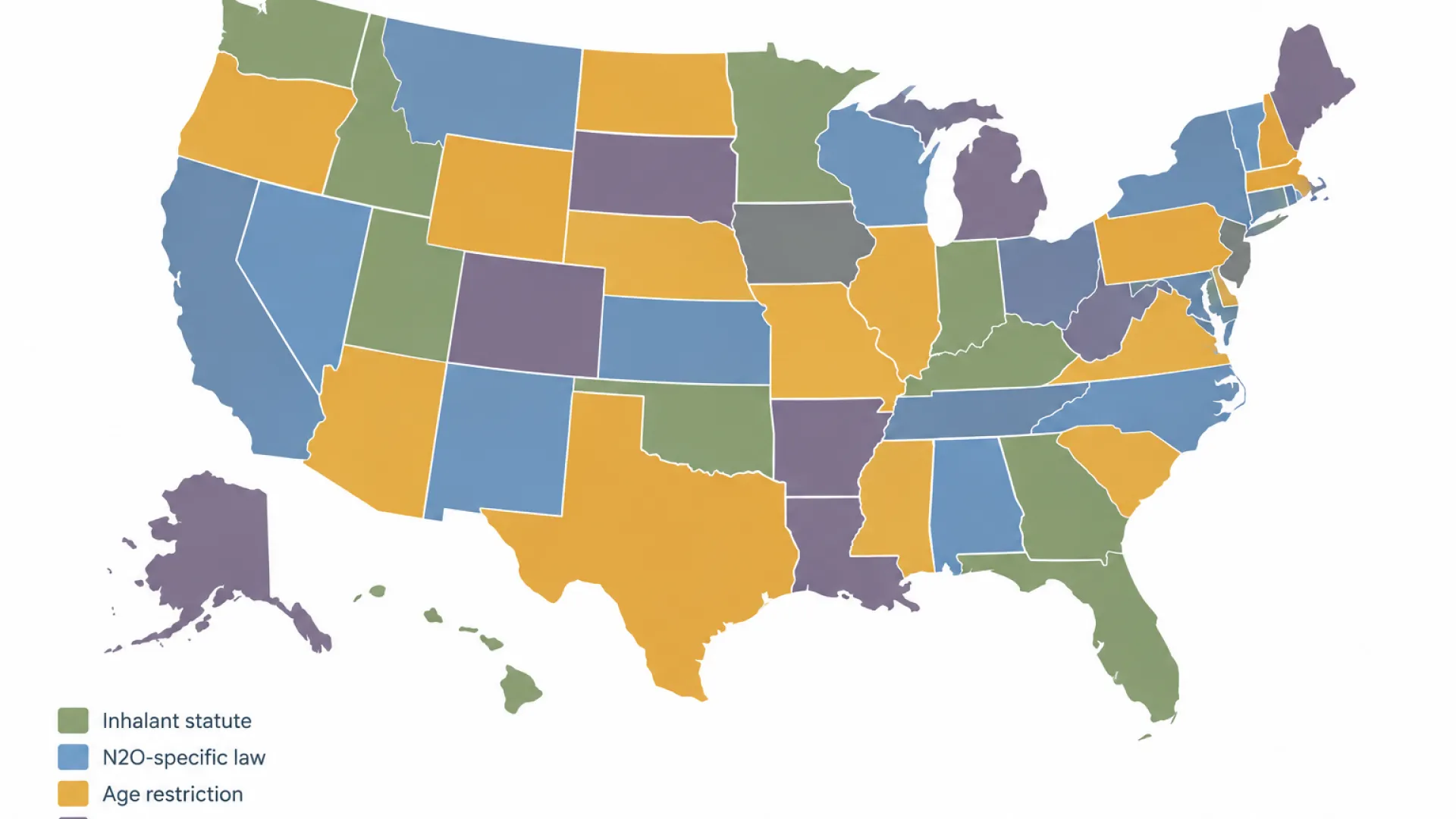
State rules look chaotic until you group them. Nearly every state law on N2O follows one of four models, and several states stack two or more of them.
| Regulatory model | What it restricts | Representative states | Typical penalty |
|---|---|---|---|
| 1. General inhalant statutes that name N2O | Sale or possession for non-culinary purposes | Texas, Maryland, New Jersey, Pennsylvania, North Dakota | Misdemeanor |
| 2. N2O-specific offense statutes | N2O named in its own criminal provision | California, Michigan, Arizona, Georgia, Ohio, Rhode Island, Utah | Misdemeanor; felony-level in Florida above 16 g |
| 3. Age-restricted retail sales | Minimum purchase age and ID checks | New York (21+), Illinois (21+), South Carolina (18+), Oregon (18+) | Civil fines for retailers |
| 4. Retail-sale bans with channel carve-outs | Consumer retail banned; food-service and wholesale channels exempt | Tennessee (2026), Louisiana (2024), South Carolina flavored products (2026); California SB 936 pending | Misdemeanor to felony, varies by state |
The direction of travel matters for buyers. Laws written before 2024 mostly target possession offenses. Laws passed in 2025–2026 target the retail shelf instead, and they consistently leave commercial food preparation channels open.
Nitrous Oxide Laws by State: 2026 Reference Table
The table below covers the states with N2O-specific or whipped cream charger legislation in force or advancing as of September 2026. States not listed generally rely on broad inhalant statutes or have no N2O-specific law; culinary purchase and use remain lawful in all 50 states. This table is a reference summary, and the linked statutes are the authoritative text.
| State | Minimum age to buy | Key sale and possession rules | Food-grade culinary exemption | Statute |
|---|---|---|---|---|
| California | 18+ | Misdemeanor to sell or furnish N2O for non-food use; retail sale of larger canisters would end under SB 936 | Yes, food preparation expressly lawful; SB 936 keeps culinary and industrial exemptions | Cal. Penal Code §381b; SB 936 (pending) |
| New York | 21+ for whipped cream chargers | Chargers require proof of age; aerosol whipped cream cans are not restricted | Yes, confirmed by the Department of Agriculture and Markets in 2022 | NY GBS §834 |
| Florida | — | Distributing or selling more than 16 g with knowledge of non-food use is a third-degree felony | Yes | Fla. Stat. §877.11(4) |
| Michigan | 18+ | Sale of devices solely containing N2O to minors prohibited; fines up to $500 | Yes | MCL 752.272a |
| Tennessee | 18+ | Retail sale of N2O products banned from July 2026; food-service and wholesale supply exempt | Yes, explicit carve-out for food products and commercial restaurant supply | Public Chapter 702 (2026) |
| South Carolina | 18+ | Sale to under-18 prohibited; flavored N2O products banned from retail | Yes, culinary use preserved | S.751 (2026) |
| Louisiana | — | General sale ban except medical, automotive, industrial, and food preparation channels | Yes, food preparation explicitly exempt | HB 64 (2024) |
| Oregon | 18+ | Sale of N2O canisters to minors prohibited; inhalant statute covers N2O | Yes | Or. Rev. Stat. (inhalant provisions) |
| Illinois | 21+ | Whipped cream charger sales require proof of age under the Whipped Cream Charger Sales Restriction Act | Yes, culinary sales lawful with ID | 815 ILCS (charger act) |
| Minnesota | — | Inhalant statute covers N2O; HF325 targets flavored N2O retail products | Yes | Minn. Stat. (inhalant); HF325 (pending) |
| Texas | — | Inhalant statute covers N2O as a misdemeanor offense | Yes | Tex. Health & Safety Code |
| Pennsylvania | — | Inhalant statute covers N2O | Yes | Pa. C.S. (inhalant provisions) |
| New Jersey | — | Inhalant statute covers N2O | Yes | N.J. Stat. (inhalant provisions) |
| Maryland | — | Inhalant statute covers N2O | Yes | Md. Code (inhalant provisions) |
| North Dakota | — | Inhalant statute covers N2O | Yes | N.D. Cent. Code |
| Arizona | — | N2O-specific misdemeanor provision | Yes | Ariz. Rev. Stat. |
| Connecticut | — | N2O offenses handled through fines | Yes | Conn. Gen. Stat. |
| Georgia | — | N2O-specific misdemeanor provision | Yes | Ga. Code |
| Ohio | — | N2O-specific misdemeanor provision | Yes | Ohio Rev. Code |
| Rhode Island | — | N2O-specific misdemeanor provision | Yes | R.I. Gen. Laws |
| Utah | — | N2O-specific misdemeanor provision | Yes | Utah Code |
| Iowa | — | Regulates N2O without a general inhalant statute | Yes | Iowa Code |
| Wisconsin | — | Regulates N2O without a general inhalant statute | Yes | Wis. Stat. |
Local governments add another layer. Nassau County, New York, for example, has moved its own nitrous oxide consumer product bill in 2026. Buyers in major metro areas should check county and city ordinances alongside state law.
California
California treats the sale or furnishing of N2O for non-food purposes as a misdemeanor carrying up to six months in county jail and a $1,000 fine under Penal Code §381b. The bigger story is SB 936, which passed the state Senate in May 2026 and reached the Assembly Appropriations Committee in August. As written, the bill would end open retail sale of N2O tanks larger than the standard 8 g whipped cream charger while keeping culinary, medical, and industrial exemptions. Food businesses sourcing through wholesale channels would continue to operate legally under the current draft.
New York
New York has required buyers of whipped cream chargers to be 21 or older since 2021 under General Business Law §834. The state Department of Agriculture and Markets clarified in September 2022 that the law covers chargers, not the aerosol whipped cream cans sold in grocery stores. Restaurants and cafés buy through normal supply channels; the obligation sits on the seller to verify age.
Florida
Florida draws the sharpest line on volume: distributing or selling more than 16 grams of N2O with knowledge of non-food use is a third-degree felony under §877.11(4). A wrongful-death lawsuit filed in Orange County in February 2025 against retailers and manufacturers has pushed many Florida stores to review their N2O shelving and labeling. Culinary wholesale supply remains lawful.
Michigan
Michigan's MCL 752.272a prohibits selling devices that solely contain nitrous oxide to minors and sets fines of up to $500. The statute targets the retail transaction, and ordinary culinary purchasing by businesses is unaffected.
Tennessee
Tennessee's Public Chapter 702 takes the retail-ban approach: consumer retail sale of N2O products ends in July 2026, while the act expressly exempts N2O sold in food products as a propellant and chargers purchased through commercial restaurant supply channels. For food businesses, the practical change is that purchasing paperwork moves from retail receipts to wholesale invoices.
South Carolina
South Carolina's S.751, signed in 2026, prohibits N2O sales to anyone under 18 and removes flavored N2O products from retail shelves. Unflavored food-grade chargers for culinary use remain available through normal channels.
The 2025–2026 Legislative Wave: New State Laws and Two Federal Bills
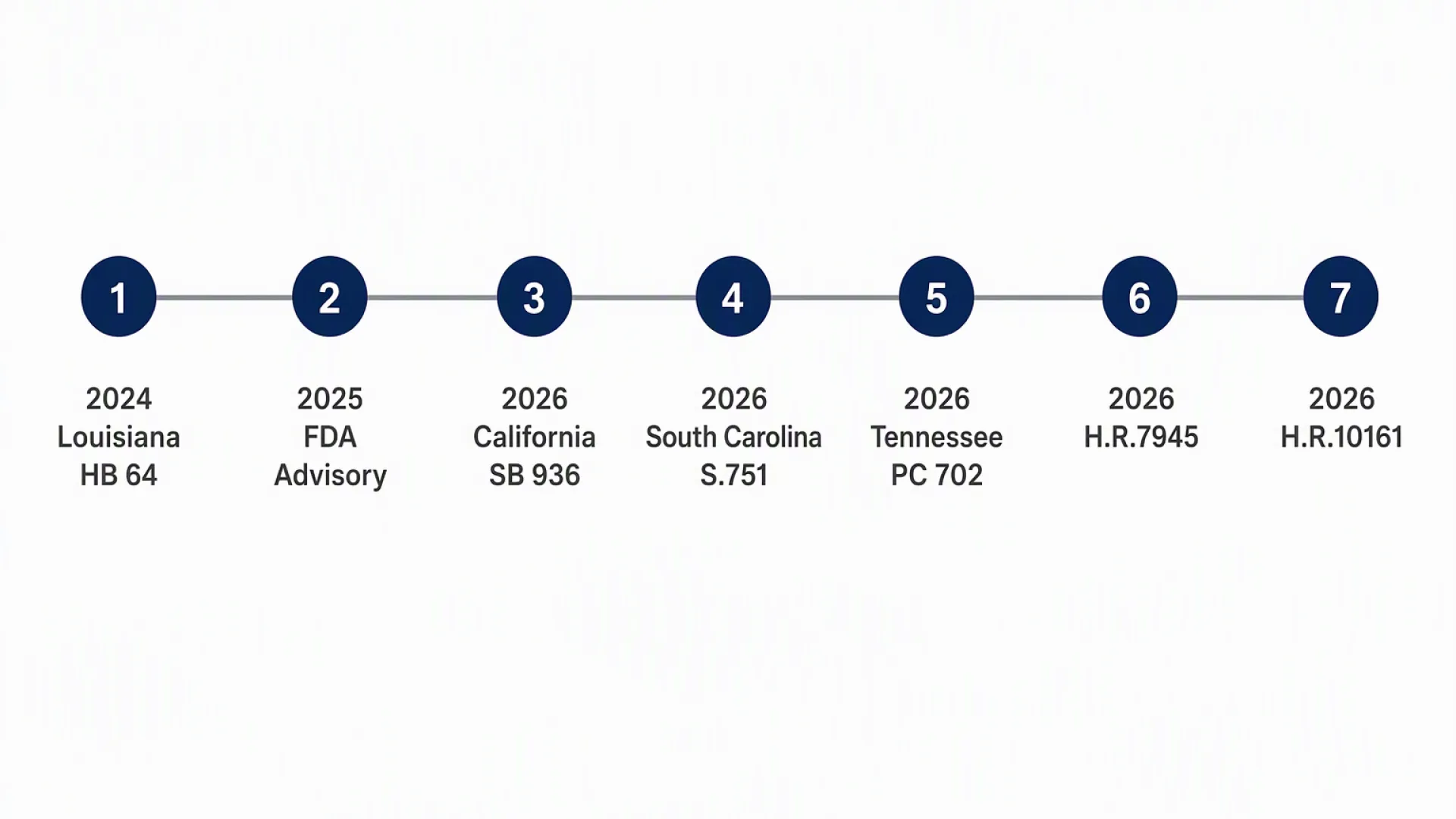
Statehouses have moved faster on N2O in the past 18 months than in the previous decade. The timeline below tracks the measures that matter most to food businesses.
| Date | Jurisdiction | Measure | Status (Sept. 2026) | Food-grade carve-out |
|---|---|---|---|---|
| 2024 | Louisiana | HB 64 retail sale ban | In force | Yes, food preparation exempt |
| June 2025 | Federal (FDA) | Consumer advisory on non-food use of flavored N2O | Advisory, not law | Food use unaffected |
| May 2026 | California | SB 936 retail sale restrictions | Passed Senate, in Assembly committee | Yes, culinary exemption in draft |
| June 2026 | South Carolina | S.751 age limit and flavored product ban | Signed | Yes |
| July 2026 | Tennessee | Public Chapter 702 retail ban | In force | Yes, food-service channels exempt |
| September 2026 | Federal | H.R.7945 Nitrous Oxide Safety Act of 2026 | Passed the House committee 36–0, awaits floor vote | Yes, food-grade exemption in draft |
| September 2026 | Federal | H.R.10161 MANNARINO Act retail restrictions | Introduced | Yes, explicit food exemption |
The two federal bills take different routes. H.R.7945 would treat N2O consumer products as banned hazardous products under the Consumer Product Safety Act 180 days after enactment, with a food-grade exemption in the current text. H.R.10161 keeps N2O legal but adds nationwide retail conditions — age verification, display limits, and an explicit food exemption. Either way, the direction for 2027 is more documentation at the point of sale, and culinary wholesale channels stay open in both drafts.
Do Food-Grade and Culinary Exemptions Still Apply?
Yes. Every restrictive state law passed to date keeps a culinary channel open, because N2O's role as a whipping propellant is written into federal food law. The exemptions differ in shape: New York restricts the buyer's age rather than the product, Tennessee and Louisiana restrict the retail shelf rather than wholesale supply, and South Carolina removes flavored products while leaving unflavored food-grade chargers in place.
Two habits make the exemption work in practice. First, buy through identifiable food-service or wholesale channels and keep the invoices — they are the clearest evidence of legitimate use if a question ever comes up. Second, keep the documentation that proves the product is food grade: a certificate of analysis and purity specification for each batch. Our guide to food-grade N2O purity and its documentation covers what those papers should contain.
What Should Food Businesses and Distributors Do Now?
Compliance work here is light compared with most regulated products. Six steps cover the exposure for a typical food business:
- Map the rules in every state where you buy, sell, or ship, including age thresholds and any county ordinances.
- Move N2O purchasing to wholesale or food-service channels where retail bans apply, and keep every invoice.
- File the certificate of analysis and purity documentation for each batch you receive.
- Apply age verification at the point of sale where state law requires it — 21+ in New York and Illinois, 18+ in South Carolina, Oregon, Michigan, and Tennessee.
- Train counter and purchasing staff on what the products are for: culinary preparation only.
- Track pending bills. California SB 936 and the two federal bills will set the compliance agenda for 2027.
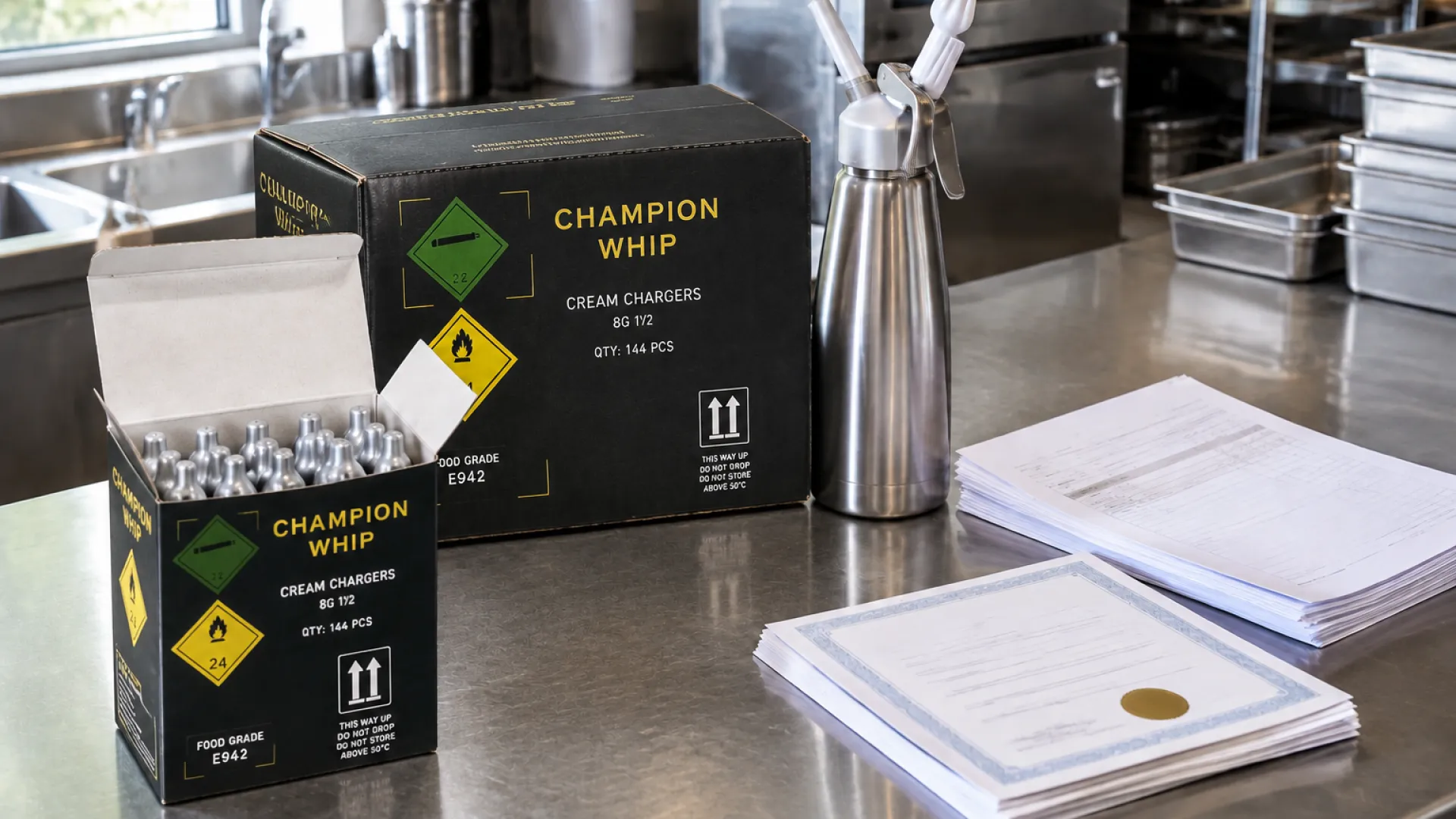
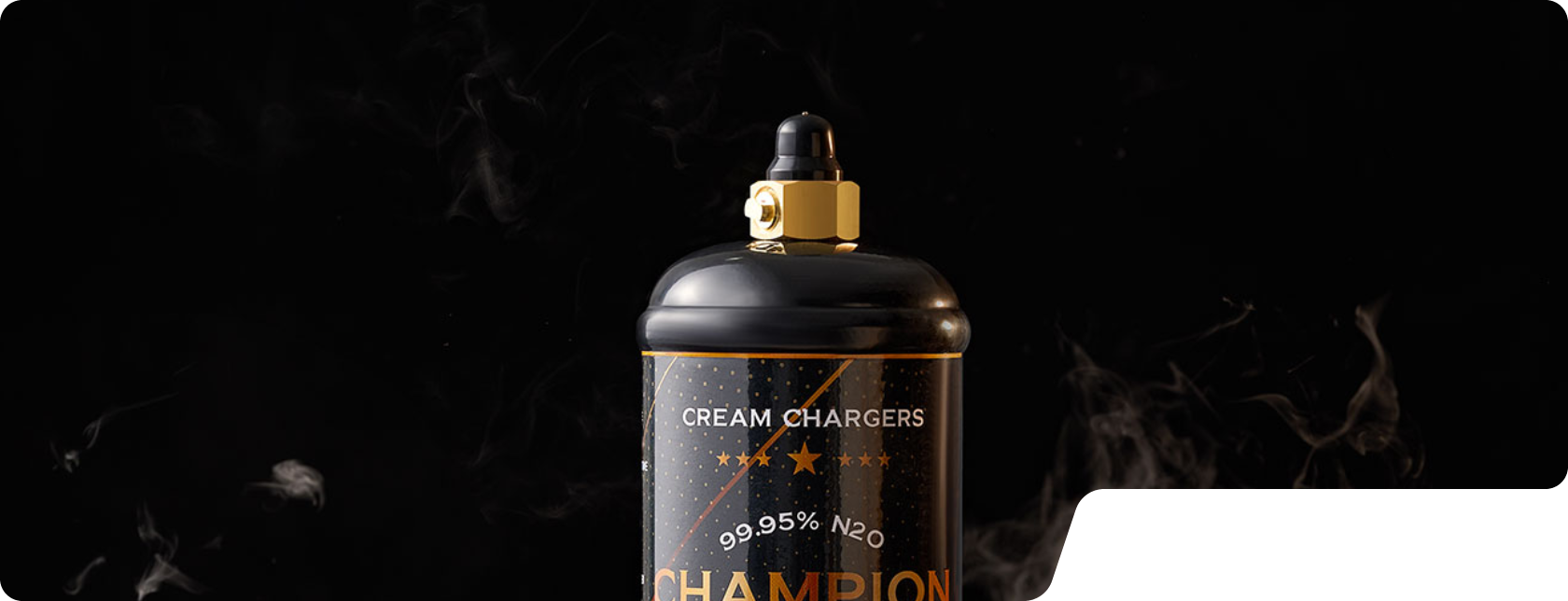
Supplier choice does part of this work for you. A manufacturer that runs FDA-registered, CE-, FSSC 22000-, and SGS-audited production can document 99.95% food-grade purity batch by batch — at Champion Whip, one unit in every hundred is sampled for purity and pressure testing. Stock held in Los Angeles and New York warehouses reaches most U.S. buyers in 2–5 days, and wholesale quotes come back within 4 hours. For supply built around these requirements, see our wholesale cream charger program.
Regulations in this space are moving quickly, and this guide reflects the landscape as of September 2026. Confirm current rules with your state authority or legal counsel before making compliance decisions.
FAQ
In what states is nitrous oxide illegal?
No state bans nitrous oxide outright. Around a dozen states prohibit its sale or possession for non-culinary purposes, Florida treats sales above 16 grams as a felony, and Tennessee ends consumer retail sales in July 2026. Culinary purchase and use remain lawful in all 50 states.
Is nitrous oxide a controlled substance?
No. Nitrous oxide is not scheduled under the federal Controlled Substances Act. The FDA regulates food-grade N2O as a GRAS food additive under 21 CFR 184.1545, and state-level sales and inhalant statutes handle the rest.
Can businesses legally buy nitrous oxide for culinary use?
Yes. Restaurants, cafes, and bakeries can legally buy food-grade N2O in all 50 states, and even states with retail bans such as Tennessee and Louisiana exempt food preparation and wholesale supply channels. Keeping invoices and batch certificates documents legitimate use.
What states do you have to be 21 to buy whipped cream chargers?
New York and Illinois require buyers of whipped cream chargers to be 21 or older with ID. Other age-restriction states, including South Carolina, Oregon, Michigan, and Tennessee, set the threshold at 18.
Are whipped cream chargers banned anywhere in the US?
No state bans culinary whipped cream chargers outright. Tennessee restricts retail sales while exempting food-service supply, and South Carolina bans flavored retail products only. Chargers sold for food preparation remain available in every state.
Do restaurants and cafes need a license to buy cream chargers?
Generally no license is required to buy or use cream chargers for food preparation. Some states place obligations on sellers instead, such as age verification and sales records, so restaurants mainly need to buy through legitimate wholesale channels.
How would the federal Nitrous Oxide Safety Act affect food businesses?
As drafted, H.R.7945 would classify N2O consumer products as banned hazardous items 180 days after enactment, but the current text keeps a food-grade exemption. Food businesses should expect more point-of-sale documentation rather than a supply interruption, and should watch the floor vote.
What records should sellers keep for whipped cream charger sales?
Keep supplier invoices, batch certificates of analysis, and purity specifications for every shipment. In age-restriction states, keep records of ID verification at the point of sale. These documents demonstrate a legitimate culinary supply chain if questions arise.

Elevate Your Creations with
Champion Whip
Explore our premium whipped cream chargers – designed for perfectionists.
View our Products


