

What Is Nitrous Oxide? Formula, Properties, and Uses
2026-11-05
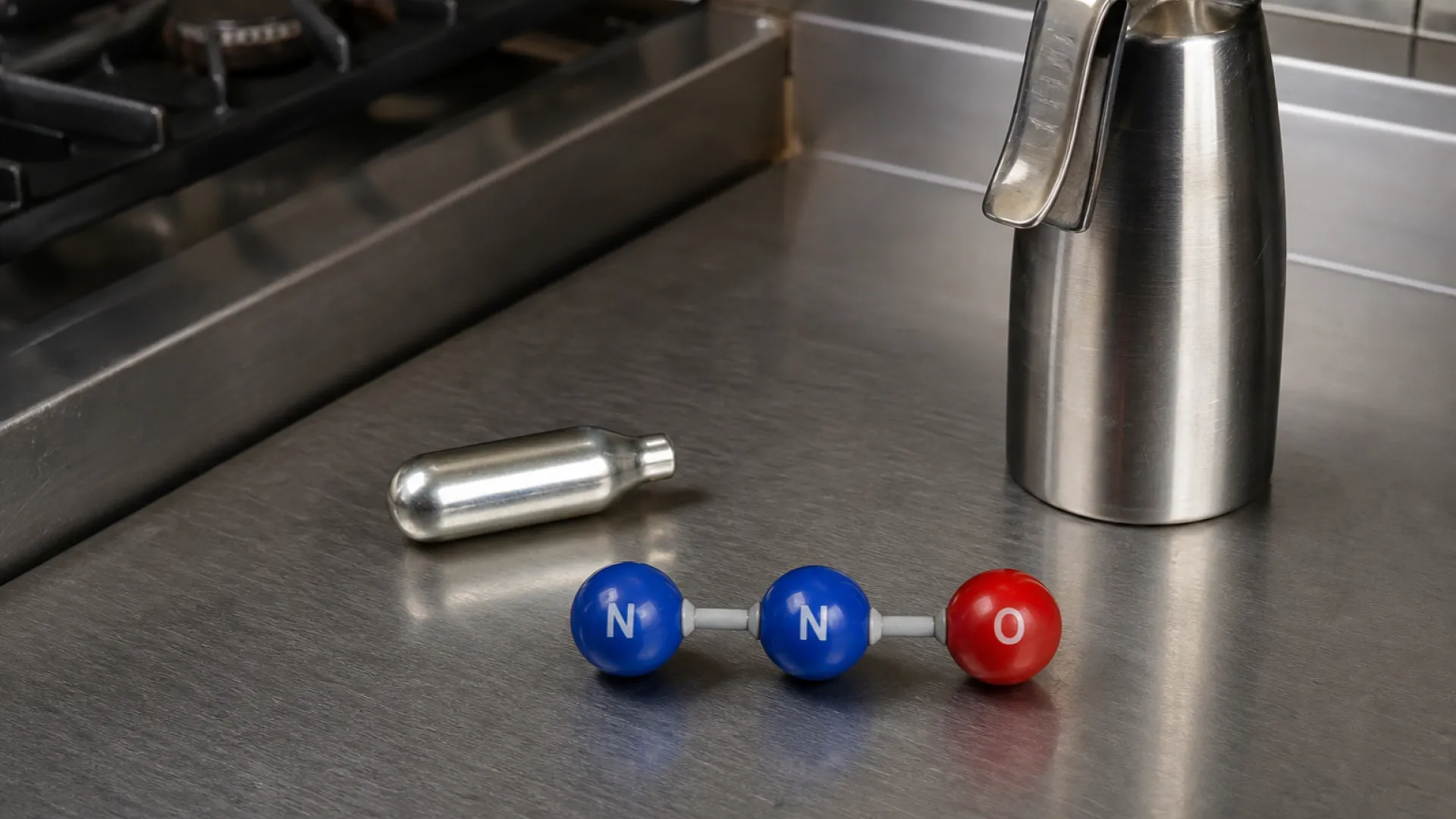
Nitrous oxide (N2O) is a colorless gas composed of two nitrogen atoms and one oxygen atom. It is used as a propellant, an oxidizing agent, and a process gas across several regulated industries. This guide explains its chemical identity, key properties, legitimate applications, and the role of food-grade N2O in culinary preparation.
What Is Nitrous Oxide?
Nitrous oxide is the common chemical name for dinitrogen monoxide, also listed as dinitrogen oxide in chemical references. Its formula is N2O, and its CAS registry number is 10024-97-2. At room temperature and atmospheric pressure, it is a colorless gas with a slightly sweet odor. Under pressure, it can be stored as a liquefied gas inside a suitable cylinder.
The name identifies the molecule. It does not define the quality or intended use of the product inside a container. N2O supplied for food preparation, healthcare, electronics, and other technical fields must meet the specifications that apply to that field. For food production, the relevant identity is food-grade N2O, supported by food-additive conformity and batch documentation.
Pressure liquefaction is important for packaging. A small cylinder can hold a usable amount of N2O in a compact form, while the valve releases it as a gas when the system is opened. This physical behavior supports measured dosing in aerosol packages and cream dispensers. It also explains why compatible valves, regulators, and storage temperatures are part of the product specification.
Nitrous Oxide Formula, Chemical Name, and Key Properties
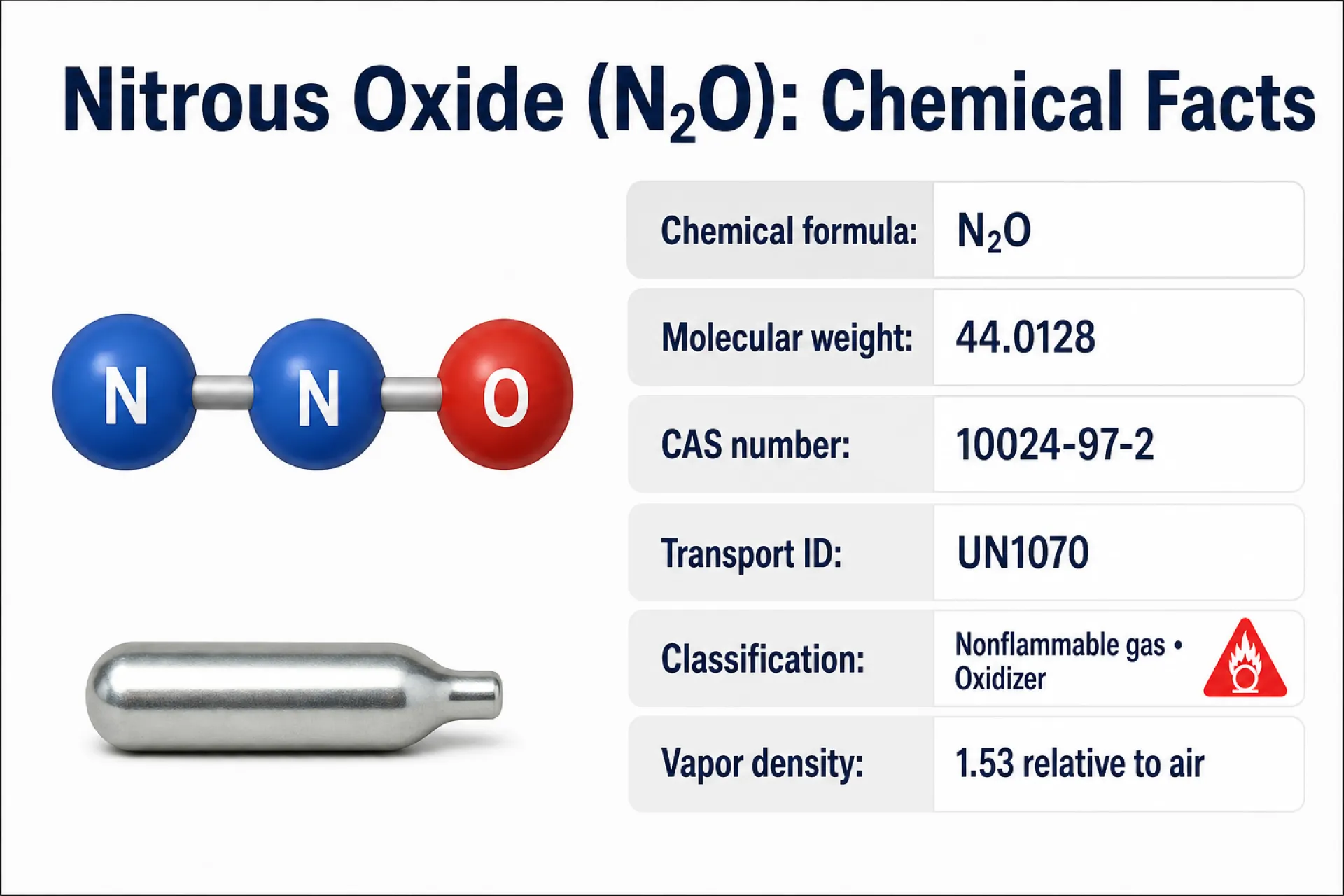
The nitrous oxide chemical formula is N2O: two nitrogen atoms and one oxygen atom. The N2O chemical name appears in technical references as nitrous oxide, dinitrogen monoxide, or dinitrogen oxide. NIST lists a molecular weight of 44.0128 and the CAS number 10024-97-2.
| Property | Verified value or classification |
|---|---|
| Chemical formula | N2O |
| Atomic composition | Two nitrogen atoms and one oxygen atom |
| Molecular weight | 44.0128 |
| CAS registry number | 10024-97-2 |
| Transport identification | UN1070, nonflammable gas and oxidizer |
| State at room temperature | Colorless gas; can be liquefied under pressure |
| Combustion behavior | Nonflammable; supports combustion |
| Vapor density | 1.53 relative to air |
Nonflammable describes the gas itself. N2O can support combustion and intensify a fire involving other materials, so storage and handling must account for heat, pressure, and oxidizing conditions. NOAA's CAMEO database classifies it as a nonflammable gas and an oxidizer, with UN1070 as its transport identifier.
NOAA also lists a vapor density of 1.53 relative to air. In a leak, N2O can therefore accumulate at low levels in poorly ventilated spaces. This is one reason storage guidance emphasizes ventilation and secured cylinders.
N2O is also distinct from NO (nitric oxide) and NO2 (nitrogen dioxide). These are different substances with different chemical properties and regulatory documents. The correct formula uses the number 2 followed by the letter O.
What Is Nitrous Oxide Used For?
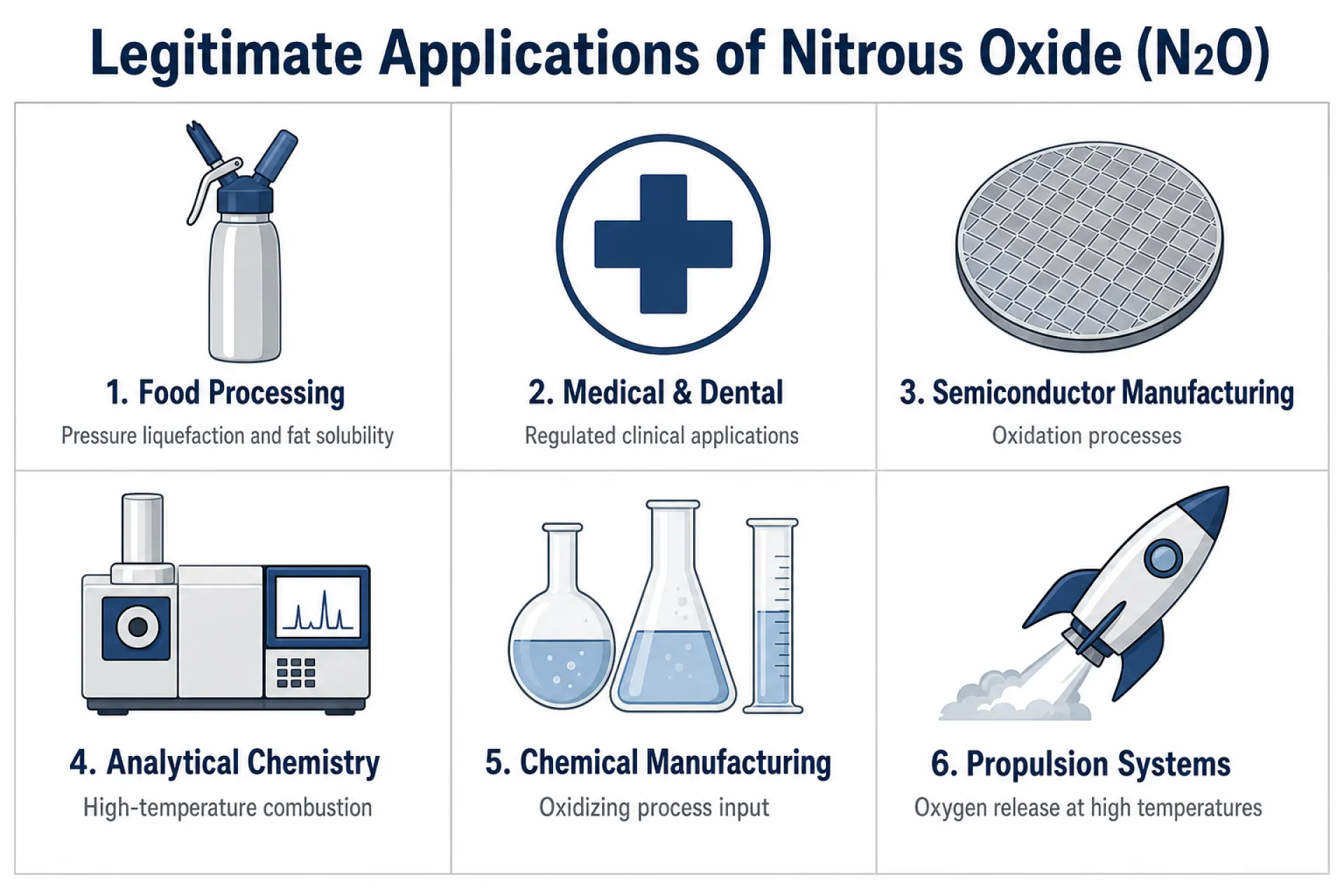
Uses of nitrous oxide cover food processing, healthcare, manufacturing, and scientific analysis. Each application relies on a particular chemical or physical property, and each sector applies its own product specification. The table connects the principal legitimate uses with the property or requirement that supports them.
| Application field | Relevant property or requirement | Typical application |
|---|---|---|
| Food processing | Pressure liquefaction, expansion on release, and solubility in fatty ingredients | Propellant and aerating agent for cream and culinary foams |
| Medical and dental | Healthcare-grade specifications and regulated administration | Controlled clinical applications |
| Semiconductor manufacturing | Oxidizing behavior under defined process conditions | Oxidation steps in electronics production |
| Analytical chemistry | Support for high-temperature combustion | Fuel gas in atomic absorption spectrophotometry |
| Chemical manufacturing | Oxidizing agent and process input | Selected chemical production processes |
| Automotive and rocket systems | Oxygen release at high temperatures | Oxidizer in specialized propulsion systems |
This property-to-application relationship matters for procurement. A food buyer needs documented food-grade gas and a container suitable for food contact. An electronics or laboratory buyer needs a specification developed for that process. A general statement that a cylinder contains N2O provides no evidence that it meets either requirement.
The Compressed Gas Association lists food processing propellant, medical and dental applications, semiconductor manufacturing, analytical chemistry, chemical manufacturing, and automotive use among the legitimate applications of nitrous oxide. These applications have separate handling rules and conformity documents, so suppliers and buyers should record the declared use before selecting a product.
Food-Grade Nitrous Oxide in Culinary Applications
Food-grade nitrous oxide is an approved food additive under major food regulatory frameworks. It is identified as E942 in the European Union and INS 942 in the Codex system. In the United States, FDA 21 CFR 184.1545 covers nitrous oxide for use as a propellant and aerating agent in food.
Common nitrous oxide uses in cooking include:
- Whipped cream: N2O aerates cream inside a pressurized dispenser and produces a fine, stable foam.
- Cold foam for coffee: a charged dispenser portions a consistent foam for iced drinks.
- Espuma: suitable fruit, vegetable, dairy, and stock bases can be dispensed as light culinary foams.
- Mousses and sauces: aeration creates a lighter texture in preparations formulated for a siphon.
- Rapid infusions: pressure accelerates flavor transfer in suitable liquid-and-ingredient combinations.
Propellant and aerating functions are related. As a propellant, expanding N2O drives the preparation toward the nozzle. As an aerating agent, it forms the bubbles that create foam. Packaged aerosol cream and a refillable dispenser both use this behavior, although their containers and supply formats differ.
Inside a sealed dispenser, N2O contacts the preparation under pressure. When the valve opens, the pressure drops and the dissolved gas expands, forming small bubbles throughout the liquid. Fat and other formulation components help stabilize those bubbles. Our article on how food-grade N2O works in a dispenser explains the complete pressure cycle.
For professional kitchens, the practical value is repeatable aeration with a neutral flavor profile when food-grade gas and clean equipment are used. Base fat, viscosity, temperature, and stabilizers still determine the result. Our guide to culinary uses of cream chargers covers the applications, serving formats, and capacity decisions in more detail.

Food-Grade vs Other N2O Grades
N2O gas is supplied in different grades because the same molecule enters different regulatory and technical systems. Food-grade gas is evaluated for food-contact use, healthcare gas follows pharmaceutical requirements, and industrial gas is specified for technical processes. The table summarizes the procurement distinction without using purity percentages as a substitute for regulatory conformity.
| Grade | Intended use | Specification basis | Typical documentation |
|---|---|---|---|
| Food-grade | Food preparation and processing | Applicable food-additive rules and food-contact requirements | Batch Certificate of Analysis, food conformity records, SDS |
| Medical or pharmaceutical grade | Regulated clinical applications | Applicable pharmacopoeial and healthcare requirements | Pharmaceutical quality and supply records |
| Industrial or technical grade | Manufacturing, analysis, and other technical processes | Specifications established for the declared technical application | Technical specification and SDS |
Food businesses should not substitute a technical-grade cylinder on the basis of price or availability. The gas specification, container, batch Certificate of Analysis, and Safety Data Sheet must all support the declared food use. Our guide to E942 rules and buyer verification explains how to check those documents.
Safe Handling and Environmental Notes
N2O is nonflammable and supports combustion. Pressure and oxidizing behavior therefore belong in the same handling procedure. Food businesses should apply three basic controls:
- Use trained staff and compatible equipment. Follow the supplier's Safety Data Sheet, inspect valves and seals, and use the regulator specified for the cylinder and dispenser.
- Control storage conditions. Keep cylinders secured in a cool, dry, ventilated area away from direct sunlight, heat, and combustible materials. Champion Whip's published storage guidance sets a maximum of 50°C (122°F).
- Keep handling records. Retain batch documents, train staff on the declared culinary use, and follow local requirements for transport, empty-cylinder return, and recycling.
N2O is also a greenhouse gas. The US EPA states that one pound of N2O has 265 times the warming impact of one pound of carbon dioxide over a 100-year period and gives an average atmospheric lifetime of about 121 years. Preventing avoidable releases, choosing an appropriate cylinder capacity, and keeping equipment in good condition are practical controls for commercial users.
Cylinder size should follow actual consumption. A container that sits unused for an extended period complicates stock rotation, while an undersized format increases packaging and handling frequency. Selecting the right capacity supports operational efficiency and responsible inventory management.
Champion Whip Food-Grade N2O Supply
Champion Whip's culinary range covers 8g cartridges through 3000g cylinders. Gas purification, cylinder manufacturing, and filling sit within one production system. The standard gas specification is 99.95% food-grade N2O, and the published quality routine pulls one unit in every 100 for purity and pressure testing. Our published quality framework lists FDA, CE, FSSC 22000, and SGS certified standards.
Warehouses in the United States, Germany, and Belgium support regional fulfillment for restaurants, cafés, distributors, and private-label buyers. Product selection should start with daily consumption, dispenser compatibility, destination-market requirements, and the documentation needed for the order.
Specifications for our 8g food-grade N2O cream chargers are available on the product page. Share your application and required capacity with our team to review a suitable supply format.
FAQ
What is nitrous oxide made of?
Is nitrous oxide flammable?
Is nitrous oxide a food additive?
What is nitrous oxide used for in cooking?
What is N20?
Is nitrous oxide NO2 or N2O?
Is nitrous oxide a greenhouse gas?
Is nitrous oxide in food safe?


Elevate Your Creations with
Champion Whip
Explore our premium whipped cream chargers – designed for perfectionists.
View our Products


