
How to Make Ice Cream with a Cream Whipper (No Machine Needed)
2026-10-26
A cream whipper charged with food-grade nitrous oxide turns a simple ice cream base into smooth, pipeable soft serve in under a minute, with no ice cream machine on the counter. The base goes in cold, the gas aerates it under pressure, and the freezer firms it into scoops. This guide gives the ratios for a 500ml whipper, the six steps from base to freezer, texture and storage rules, and a cost comparison for small dessert shops weighing a machine against a whipper.
How an Ice Cream Machine Works — and Why a Cream Whipper Can Replace It
An ice cream machine freezes a liquid base inside a chilled cylinder while a rotating blade, the dasher, scrapes the walls and beats in air so ice crystals stay small. A cream whipper reaches a similar texture by a different route: food-grade N2O dissolves into the cream's fat under pressure, then expands into millions of micro-bubbles as the mix leaves the nozzle, and the freezer sets the aerated base afterward.
The machine's job is crystallization control. The cylinder walls run far below freezing, the dasher keeps the mix moving so crystals stay fine, and air builds to 20–50% of the finished volume, a figure the trade calls overrun. Batch freezers produce firm scoops; soft-serve machines hold the product at serving temperature. The results are excellent, at the cost of a dedicated appliance, counter space, and daily cleaning cycles.
The whipper handles aeration before freezing. Inside the sealed vessel at roughly 10 bar, N2O dissolves into the fat phase of the cream. When the lever opens the valve, pressure drops to room level in a fraction of a second, the dissolved gas expands, and fat globules trap the bubbles as a fine, uniform network. Because the base is already full of microscopic air — and partly chilled by the gas expansion itself — the freezer only has to firm it, and crystals stay small. The full pressure cycle, part by part, is covered in our article on how a whipped cream dispenser works.
Ingredients and Ratios for Whipper Ice Cream
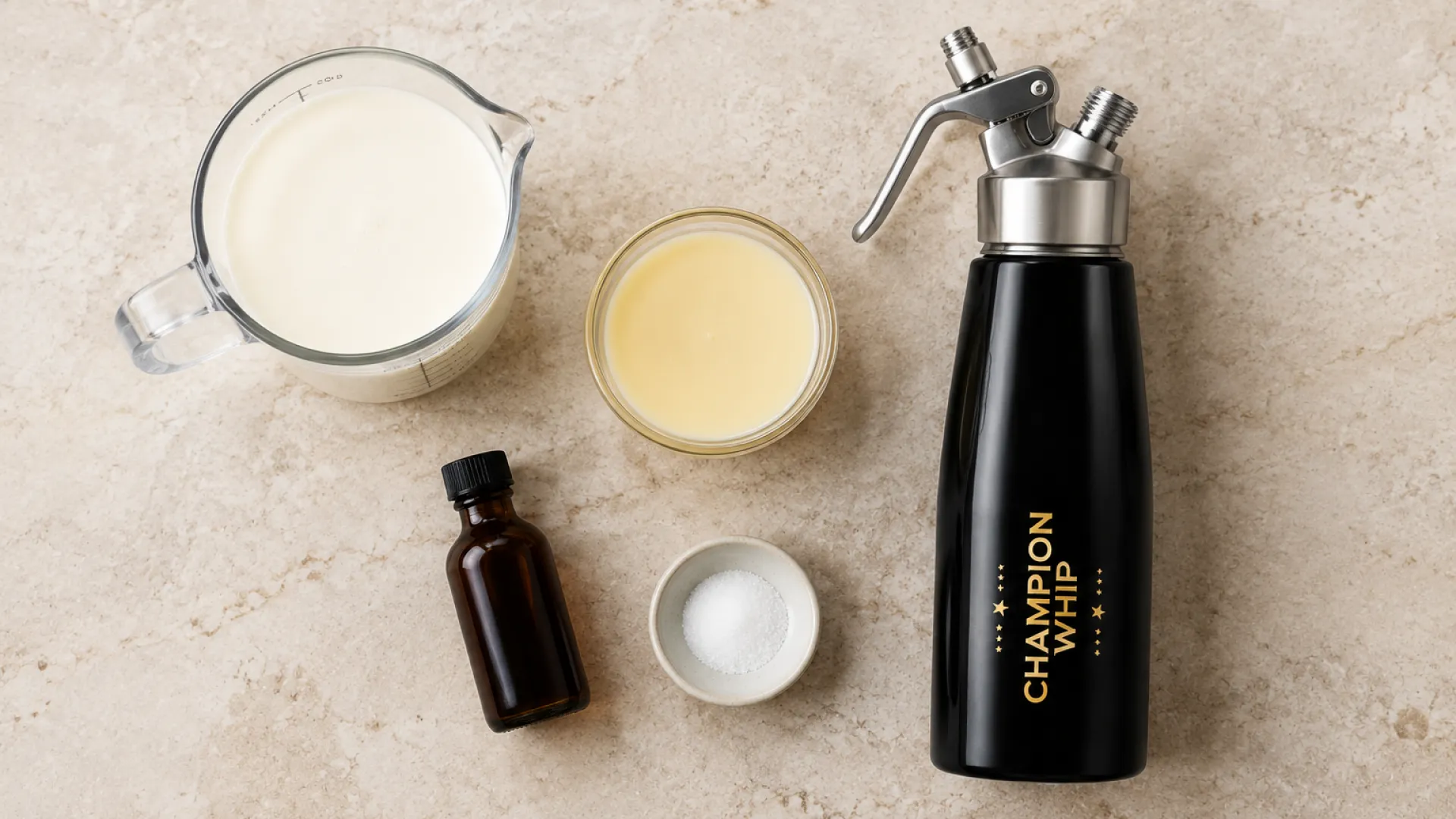
The base below fills a 500ml whipper to its max line and yields four to five servings. Every ingredient has a job, and the fat and sugar percentages decide the final texture.
| Ingredient | Amount (500ml whipper) | Role |
|---|---|---|
| Heavy cream, 35–40% fat | 360 ml (about 370 g) | Fat globules form the scaffold that traps the gas bubbles |
| Sweetened condensed milk | 120 ml (about 150 g) | Sugar lowers the freezing point and keeps the texture scoopable |
| Vanilla extract | 1 tsp | Base flavor |
| Fine salt | 1 pinch | Rounds out the sweetness |
Three rules keep the base workable. First, fat stays at 30% or above; below that the foam drains and the frozen result turns icy. Second, sugar lands around 15% of the base weight; less sugar means a harder, icier freeze. Third, the total volume respects the whipper's max-fill line, because the headspace above the liquid is where the gas does its work.
Three flavor variants that hold up to charging and freezing: chocolate (2 tbsp sifted cocoa plus 40 g melted, cooled dark chocolate), coffee (2 tsp instant espresso dissolved in 1 tbsp warm cream, cooled before mixing), and strawberry (80 g purée reduced by half on the stove, strained, and chilled).
How to Make Ice Cream Without a Machine: 6 Steps in a Cream Whipper
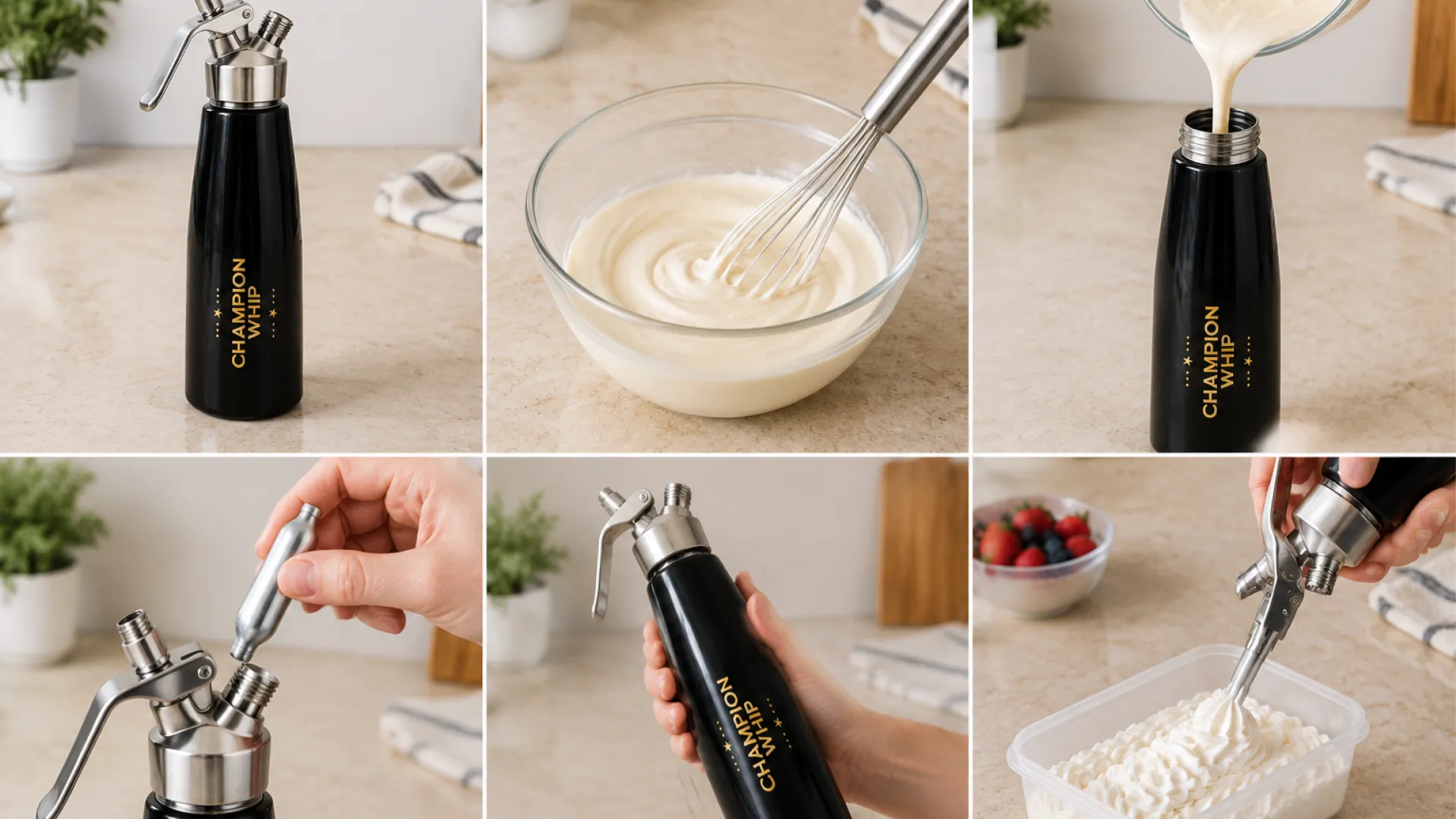
- Chill everything. Whipper, cream, and the storage container all start at refrigerator temperature. Warm fat releases gas unevenly and the foam comes out runny.
- Mix the base. Stir the cream, condensed milk, vanilla, and salt until uniform. No whipping at this stage; the air enters later from the charger.
- Fill to the line. Pour the base into the whipper and stop at the max-fill mark. Overfilling leaves no headspace for the gas and produces dense, heavy output.
- Charge. Screw on one 8g food-grade N2O charger until the hiss stops. For a firmer foam that pipes taller, vent the first charger into the mix, then fit a second one. High-volume service can run the same fill through a pressure regulator on a large cylinder instead of single cartridges.
- Shake 20–30 times. Shaking multiplies the contact surface between gas and cream. Fewer shakes leave undissolved gas in the headspace; far more shakes thicken high-fat cream inside the valve and set up a clog.
- Dispense and freeze. Hold the whipper upside down, press the lever, and pipe the aerated base into a chilled, freezer-safe container. Smooth the surface, cover, and freeze 3–4 hours; overnight gives a firmer scoop.
Texture: Soft Serve Now or Scoopable Later
Straight from the nozzle, the mix has a soft-serve texture: smooth, glossy, and pipeable onto cones or between cookies. After 3–4 hours in the freezer it firms into clean scoops, and an overnight freeze gives a hard-pack texture close to churned ice cream.
Icy results trace back to three causes. Fat below 30% leaves too much free water to crystallize. Watery mix-ins, such as fresh fruit chunks, introduce local ice pockets; cook purées down first. An undercharged or under-shaken whipper leaves the base flat, and a flat base freezes into coarse crystals. Each fix sits in the ratios and steps above.
For storage, press a sheet of wrap onto the surface, seal the container, and keep it in the coldest part of the freezer. Texture stays at its best for about a week; after that, slow recrystallization makes each serving grainier, the same drift covered in our whipped cream storage and shelf-life guide.
One honest limit: hard-pack scooped ice cream at volume, held in a display cabinet for days, still belongs to a batch freezer. The whipper method wins on speed, portion flexibility, and equipment cost.
Other Ways of Making Ice Cream Without a Maker
The whipper method is one of five workable no-machine routes. This table puts it next to the four classics so you can match the method to the equipment you already own.
| Method | Equipment | Active time | Texture | Batch consistency |
|---|---|---|---|---|
| Cream whipper + N2O | Whipper, charger, freezer | About 10 min + freeze | Soft serve to scoopable | Uniform batch after batch |
| Two-ingredient no-churn | Hand or stand mixer | About 10 min + 6 h freeze | Rich and dense | Uniform |
| Ice-and-salt bag | Two bags, ice, coarse salt | 5–8 min hard shaking | Soft, sometimes uneven | Varies by shaking effort |
| Freeze-and-stir | Steel dish, spatula or mixer | 2–3 h of repeated stirring | Decent if stirred often | Varies by timing |
| Food processor or blender | Freezer plus processor | Freeze solid, then pulse | Smooth | Uniform |
The whipper column stands out on repeatability: the charger meters the aeration, so the tenth batch matches the first without extra arm work. If chargers are the missing piece, a dispenser can still be loaded with a hand-whipped base — the texture comes out coarser, and the trade-offs are covered in our guide to using a whipped cream dispenser without a charger.
For Small Dessert Shops: Ice Cream Machine or Cream Whipper?
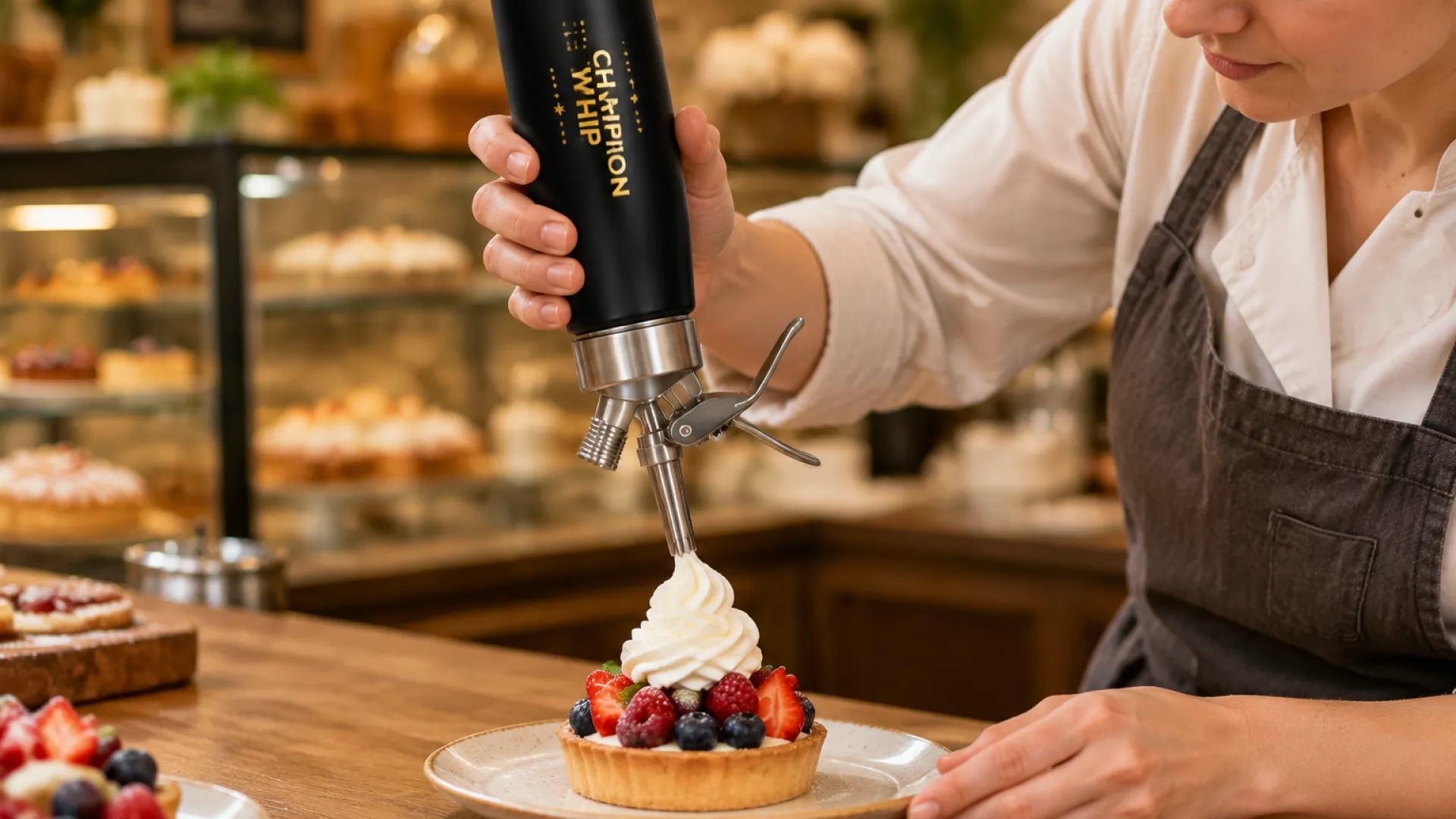
The equipment decision comes down to volume and menu style. A commercial ice cream machine runs from a few hundred dollars for an entry unit to several thousand for a floor model, and it earns that cost back when scooped ice cream is a daily, steady seller. It also claims counter or floor space, a dedicated power circuit in some cases, and a daily cleaning routine.
A whipper plays a different role. Most cafés and dessert shops already own one for whipped cream and foams, so the marginal equipment cost is zero. One 8g charger aerates a 500ml batch into four to five servings; at wholesale pricing, the gas cost per serving comes to a few cents. Because each batch takes minutes, a shop can hold two or three bases in separate whippers and pipe flavors to order — a single-origin coffee soft serve at noon, a strawberry version for the afternoon menu — with no machine changeover. The same whipper also covers espuma, mousses, and cocktail foams, which spreads its cost across the menu; our espuma recipe guide maps those applications.
The practical rule: above roughly fifty scooped servings a day, a machine pays for itself; below that line, or for a seasonal special, the whipper method adds an ice cream item at near-zero equipment cost.
Champion Whip: Chargers and Whippers for Dessert Service
The method in this guide runs on two inputs: a vessel that holds pressure fill after fill, and gas of verified food-grade purity. Champion Whip manufactures both. Our 500ml stainless steel whipper is pressure-tested to 30 bar with a fully serviceable valve, and our E942 food-grade 8g chargers are filled at our own facility, with 640g and larger cylinders plus regulators available for higher-volume service. Warehouses in the US, Germany, and Belgium hold regional stock for wholesale orders.
For wholesale pricing on chargers, whippers, and spare gaskets, send your volume through the wholesale page and we will quote within one business day. Product details: 500ml stainless steel cream whipper and 8g food-grade cream chargers.
FAQ
Do you really need an ice cream maker to make ice cream?
Can I make ice cream using a blender?
What can I use instead of an ice cream machine?
What is poor man's ice cream?
Why is my homemade ice cream icy?
Can you make ice cream in a whipped cream dispenser?
How long does whipper-made ice cream last in the freezer?
Can I use a cream whipper without a charger for ice cream?


Elevate Your Creations with
Champion Whip
Explore our premium whipped cream chargers – designed for perfectionists.
View our Products


