

How Does a Whipped Cream Dispenser Work? The Mechanics Explained
2026-07-27
A whipped cream dispenser turns cold liquid cream into finished foam in seconds, and the whole process runs on a single pressure cycle: gas dissolves into the cream while the vessel is sealed, then expands as the cream leaves the nozzle. This article breaks that cycle down stage by stage — the parts involved, the pressures at work, and the failure points that show up in daily service.
The chemistry of the gas itself sits outside the scope of this piece. For the molecular side — why N2O binds so well to dairy fat — see our article on how nitrous oxide works. Here the focus stays on the machine.
The design is older than it looks. Charles Getz, a chemistry graduate student at the University of Illinois, developed pressurized aerosol cream in the early 1930s. His first trials used CO2, which foamed the cream but soured its taste; switching to N2O solved both problems, and his professor G. Frederick Smith turned the patent into Instantwhip Foods. The dispensers on today's coffee bars run on the same principle Getz published ninety years ago.
The Short Answer
A whipped cream dispenser works by forcing nitrous oxide into liquid cream under pressure, holding the mixture sealed until the gas dissolves into the cream's fat, then releasing it through a valve. As the cream exits the nozzle, pressure drops from roughly 10 bar to normal air pressure in a fraction of a second. The dissolved gas comes out of solution and expands into millions of tiny bubbles, and the cream's fat globules trap them as a stable foam. One 8g charger pressurizes a half-litre fill. There is no motor and no whisk inside the vessel — the pressure cycle does all the work.
The Pressures Involved
Three pressure values define the system, and knowing them explains both the performance and the safety margin.
| Location | Pressure | What It Means |
|---|---|---|
| Inside an 8g charger (20°C) | 52 bar (754 psi) | Liquefied N2O held in a steel capsule; burst pressure above 500 bar |
| Inside a charged dispenser | ~10–11 bar (145–160 psi) | Typical working pressure after charging a half-litre fill |
| Vessel design limit | 20 bar (0.5L) / 30 bar (1L) | Manufacturer-stated maximum working pressure (iSi manual figures) |
The spread between these numbers is the safety case. The vessel is rated at roughly double its normal working pressure, and the charger shell is engineered for ten times what it ever sees after piercing.
Key Parts and What They Do
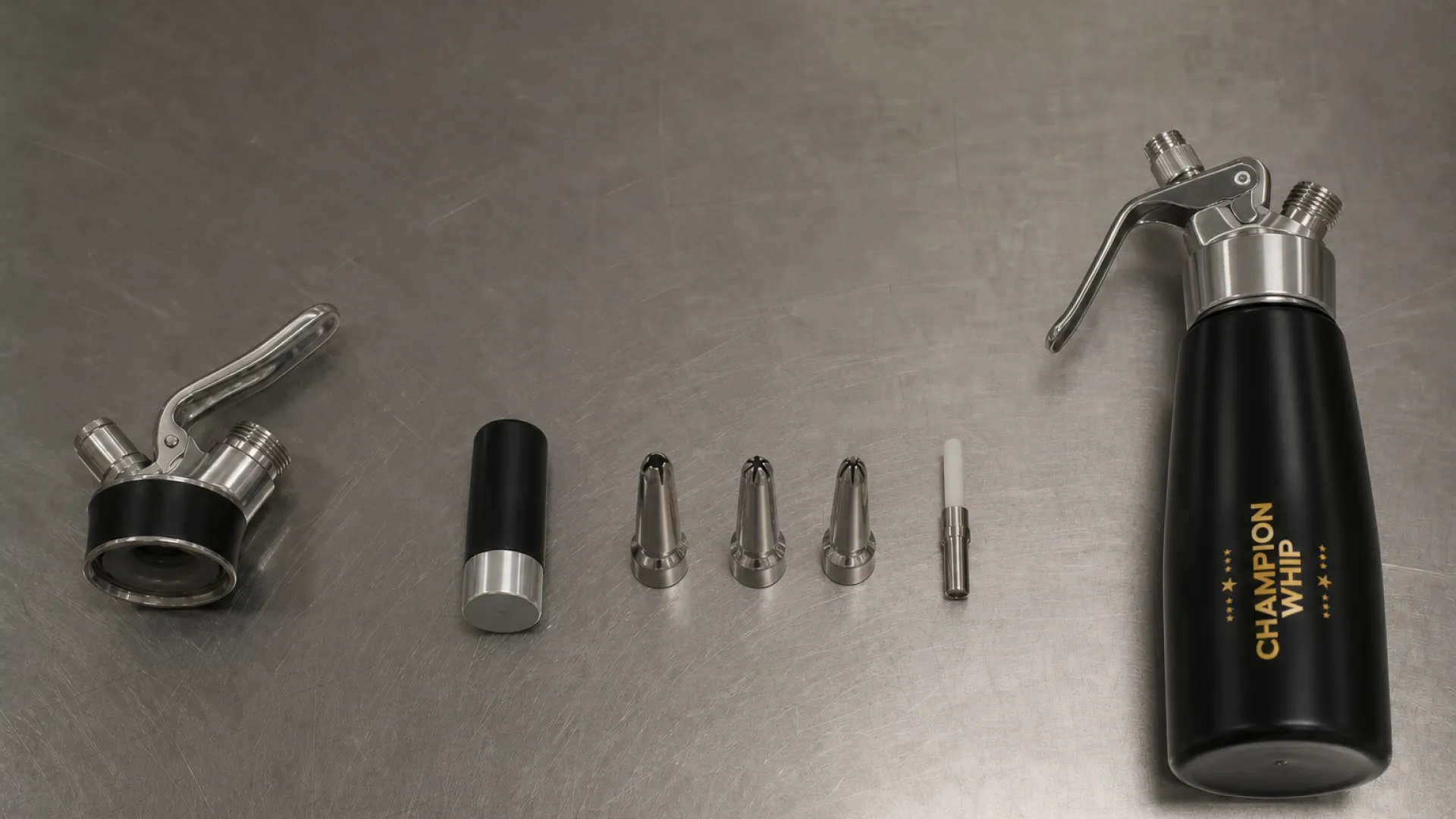
A dispenser has six functional parts. Each one maps to a specific stage of the cycle, and each has a characteristic failure mode covered later in this article.
- Canister. The pressure vessel, usually 250ml, 500ml, or 1L. It holds the cream and the pressurized headspace. Food-grade stainless steel handles daily commercial dishwashing; aluminum is lighter and cheaper.
- Head. The assembly that seals the canister and carries the valve, the lever, and the nozzle mount. Thread quality here decides how long the seal lasts.
- Valve and piston. The gate of the system. Pressing the lever lifts the piston and lets pressurized cream flow to the nozzle. A valve that sticks or clogs disables the whole unit.
- Gasket. The silicone ring that seals head to canister. It is a consumable: flattened or nicked gaskets are behind most pressure leaks.
- Charger holder. The cup that accepts a standard 8g charger. A piercing pin inside it opens the charger's foil seal as the holder is screwed down.
- Decorator nozzle. Shapes the outgoing foam and restricts flow enough to control the expansion. It is also the narrowest passage in the system, so it clogs first.
The Working Cycle in Three Stages
Stage One: Piercing the Charger
Screwing the charger holder down drives the piercing pin through the charger's foil seal, a disc about 0.4mm thick. The 52 bar inside the capsule dumps into the headspace of the canister in about a second — the hiss you hear is that transfer. The steel capsule empties completely and can be unscrewed and discarded. At this point the gas sits mostly in the empty space above the cream, which is why the next stage needs shaking.
Stage Two: Dissolving the Gas
N2O is far more soluble in fat than in water, a property Modernist Cuisine credits for the siphon's strong performance with high-fat liquids. Under the headspace pressure, gas diffuses into the cream and binds into the fat phase; the amount dissolved scales with the partial pressure above the liquid, the relationship described by Henry's law. Shaking 20 to 30 times multiplies the contact surface and moves dissolution from minutes to seconds. Temperature matters here: cold fat stays firm and holds the dissolved gas in place, while warm cream takes up less gas and releases it unevenly. One caution applies to high-fat cream — shaking past the recommended count thickens it inside the valve and sets up a clog.
Stage Three: Dispensing and Expansion
Pressing the lever opens the valve, and headspace pressure pushes cream up through the valve body and out of the nozzle. At the exit, the cream meets normal air pressure. The dissolved N2O boils out of solution and expands, and the network of fat globules traps the gas as micro-bubbles. The foam that lands on the plate measures two to three times the volume of the liquid that went in, with four times achievable on lean preparations. Because the bubbles form inside the cream rather than being beaten in from outside, the texture is finer and more uniform than mechanically whipped cream, and a 500ml fill yields roughly ten servings. The sealed vessel then keeps the charged cream usable for about a week in the refrigerator, since the pressurized N2O atmosphere suppresses bacterial growth — one reason cafés prep a dispenser in the morning and serve from it through the day.
Why Fat Content and Temperature Decide the Result
The mechanism above has two hard prerequisites, and most "my dispenser doesn't work" complaints trace back to one of them.
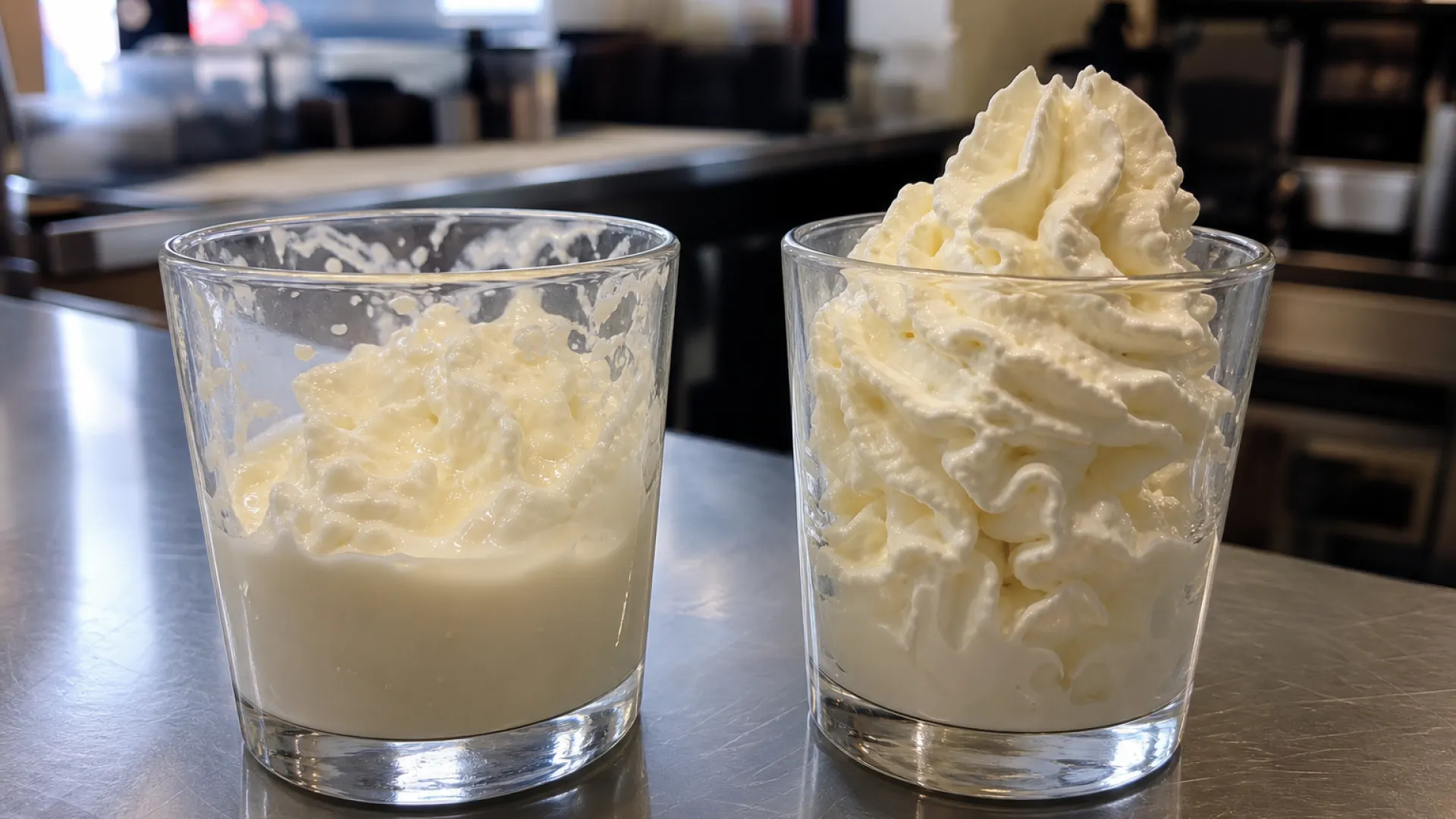
- Fat content. iSi rates 30–36% fat as the working range, with 30% as the practical floor. Fat globules form the scaffold that holds the bubbles; below that threshold the foam drains and sags within minutes.
- Temperature. Cream and canister go in cold. UHT cream needs 24 hours of refrigeration before use, no liquid should ever enter the vessel above 40°C, and the minimum working temperature is 1°C. Warm fat softens and loses its grip on the gas, so the cream dispenses runny no matter how many chargers you add.
Common Failures and What Causes Them
Field complaints cluster around six symptoms. Each maps to a specific part or step in the cycle.
| Symptom | Likely Cause | Fix |
|---|---|---|
| Cream comes out liquid | Warm cream or canister, fat below 30%, no shaking, overfilled vessel | Chill everything, use heavy cream, shake 20–30 times, respect the fill line |
| Gas leaks at the head | Gasket misseated, cut, or flattened | Reseat or replace the gasket, tighten the head squarely |
| Nothing dispenses | Valve blocked or damaged; charger not fully pierced | Disassemble and clean the valve; check the charger holder pin |
| Cream sprays during charging | Head valve damaged | Stop use and service the valve assembly |
| Head won't unscrew | Overcharged vessel | Wrap in a towel and open slowly to vent pressure |
| Metallic or sour taste | CO2 charger used by mistake | Use food-grade 8g N2O cream chargers; CO2 acidifies cream |
Two parts account for the bulk of these failures: the gasket and the valve. Monthly inspection of both keeps a commercial unit in service for years, and spare gaskets cost less than a single wasted fill.
Chargers and Dispensers for Daily Commercial Use
The cycle described here depends on two inputs: a vessel that holds its rated pressure fill after fill, and gas of verified food-grade purity. Champion Whip supplies the 500ml stainless steel whipper, pressure-tested to 30 bar and built around a fully serviceable valve, alongside E942 food-grade 8g chargers filled at our own facility. For wholesale pricing on chargers, dispensers, and spare gaskets, send your volume through the wholesale page and we will quote within one business day. Operators who want the usage routine first can also read our step-by-step guide to using a cream charger.
FAQ
How does a whipped cream dispenser make whipped cream?
It pressurizes liquid cream with nitrous oxide from a small charger, lets the gas dissolve into the cream's fat while sealed, then releases the cream through a valve. At the nozzle the pressure drops to normal air, the dissolved gas expands into millions of micro-bubbles, and the fat globules trap them as stable foam — all in seconds, with no whipping.
What is the pressure inside a whipped cream dispenser?
A charged half-litre dispenser runs at roughly 10–11 bar (145–160 psi). The 8g charger itself holds 52 bar at room temperature, and commercial vessels are rated well above working pressure — 20 bar for 0.5L models and 30 bar for 1L models in iSi's published specifications.
Why is my whipped cream coming out liquid?
Runny output has four common causes: warm cream or a warm canister, cream with less than 30% fat, no shaking after charging, or an overfilled vessel with too little headspace. Chill the cream and the unit, use heavy cream, shake 20–30 times after each charger, and respect the fill line.
How many chargers does a whipped cream dispenser need?
One 8g charger for 0.25L and 0.5L dispensers; two chargers for a 1L unit. Each charger is designed to pressurize up to half a litre of liquid. Shake after every charger, and stop at the manufacturer's stated count — extra chargers over-pressurize the vessel.
Can I use CO2 instead of N2O in a whipped cream dispenser?
No. CO2 dissolves into the water phase of cream and forms carbonic acid, which gives the foam a sour, metallic taste and a coarser texture. Whipped cream dispensers are designed for food-grade N2O (additive E942), which dissolves into the fat phase and leaves no taste.
Why is gas leaking from the head of my dispenser?
Almost always the gasket. A gasket that is misseated, cut, or flattened lets gas escape around the head threads. Reseat it first; if the leak continues, replace it. Gaskets are cheap consumables, and keeping spares on hand is standard practice in commercial kitchens.
Can you overcharge a whipped cream dispenser?
Yes. Adding chargers beyond the rated count raises internal pressure past the working range, and the head can become difficult to unscrew. If that happens, wrap the head in a towel and open it slowly to vent pressure. Staying at one charger per half-litre fill prevents the problem entirely.
How long does whipped cream last in a dispenser?
About one week refrigerated in the sealed, charged canister, and up to two weeks when the cream contains sugar or a stabilizer. The pressurized N2O atmosphere inside the closed vessel suppresses bacterial growth. Discard the cream if it smells sour or dispenses watery.


Elevate Your Creations with
Champion Whip
Explore our premium whipped cream chargers – designed for perfectionists.
View our Products


