

What Is a Cream Charger? A Complete Guide From a Factory's Perspective
2026-05-06
If you've ever ordered a coffee with a perfect cloud of cream on top, or watched a chef finish a dessert with a fluffy swirl in two seconds — that's a cream charger doing the work behind the scenes. They're small, simple, and most people who use them don't know what's actually inside or how to tell a good one from a bad one.
This guide walks through what a cream charger is, how it works, what it's used for, and the things that actually matter when you're choosing one — written from the perspective of a factory that has been making them for over a decade.
What a Cream Charger Is
A cream charger is a small steel cylinder filled with food-grade nitrous oxide (N2O) under pressure. It's used together with a whipped cream dispenser (sometimes called a whipper or cream siphon) to instantly turn liquid cream into stable, fluffy whipped cream — no manual whisking, no electric mixer.
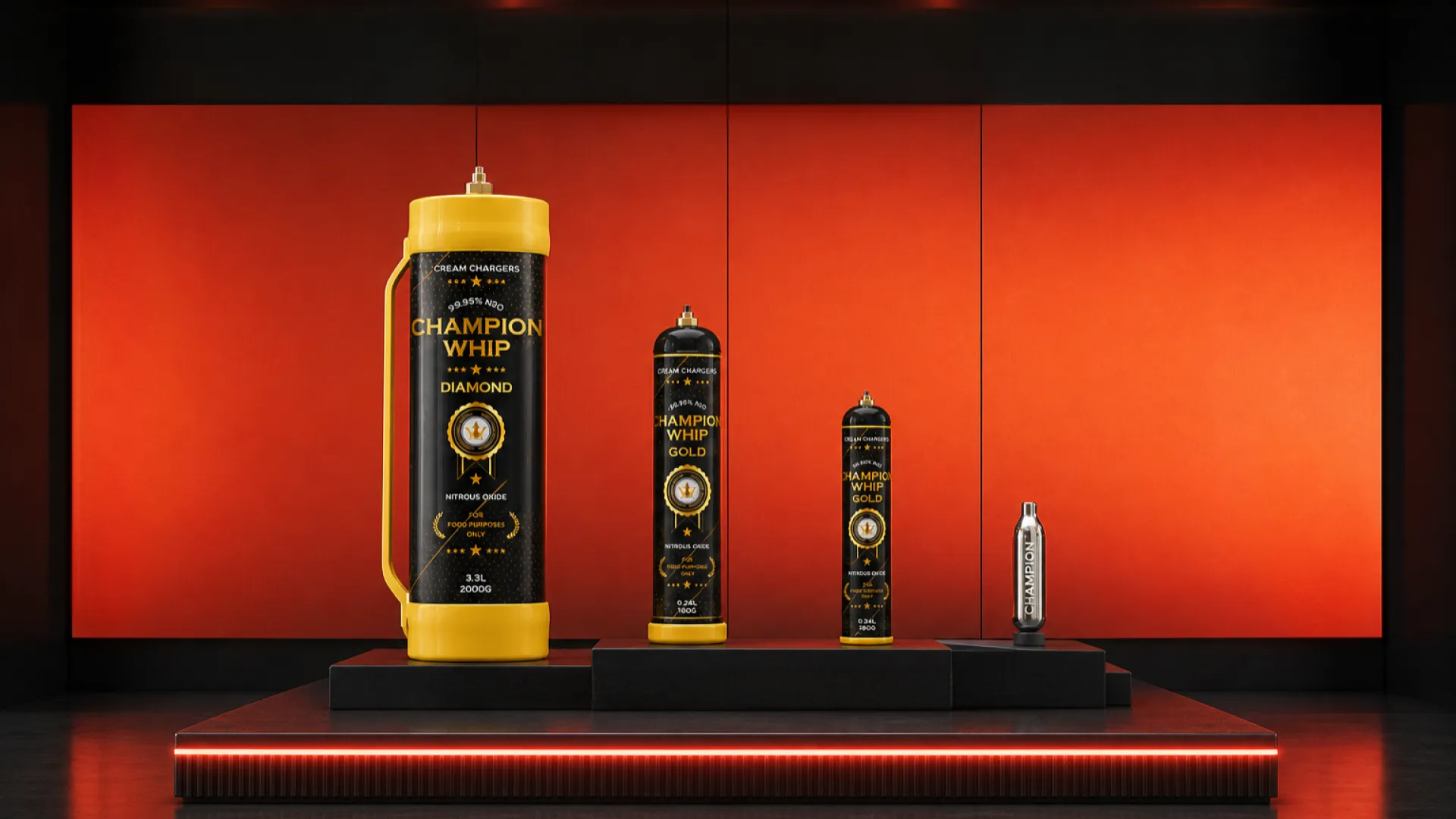
The standard charger is single-use, made entirely of recyclable steel, and contains 8 grams of N2O. It's about 6.3 cm long and 1.8 cm wide, with a foil-sealed tip at one end. When you screw it into a dispenser, an internal pin pierces that foil, releasing the gas into the cream chamber.
That's the basic version. In professional kitchens, the same principle scales up to large cylinders holding 320g, 640g, 2000g or even 3000g of N2O — with a pressure regulator added in between to control the flow. The science is the same. Only the volume changes.
How a Cream Charger Works
The mechanism is straightforward but worth understanding, because it explains why some chargers give you stiff, stable whipped cream and others give you watery foam that collapses in a minute.
When the foil seal is pierced, pressurized N2O rushes into the dispenser and dissolves into the cream's fat molecules. The dispenser is now a pressurized chamber. When you press the lever, the cream is forced out through the nozzle, and the sudden pressure drop causes the dissolved gas to expand into thousands of tiny bubbles inside the cream. That's what creates the light, airy texture.
Three properties of N2O make this work:
- It dissolves into fat, not water. This is why cream needs at least 30% fat content (heavy cream, whipping cream) — there has to be enough fat for the gas to bind to. Skim milk won't whip.
- It's neutral and tasteless. Unlike CO2, which produces a sour, metallic taste in cream, N2O leaves the flavor untouched.
- It's bacteriostatic. N2O inhibits bacterial growth, which is why a charged dispenser can sit in the fridge for up to two weeks without spoiling.
What Cream Chargers Are Used For
The obvious use is whipped cream — for desserts, coffee, hot chocolate, ice cream sundaes. But the actual range of culinary applications goes far beyond that. In a professional kitchen, a cream charger and dispenser combination is one of the most versatile tools you can have.
| Application | What It's Used For |
|---|---|
| Whipped Cream | Standard sweet cream for desserts, coffee, and pastries |
| Espumas & Savory Foams | Light foams of stock, vegetable purée, or cheese for fine dining |
| Mousses | Quick chocolate, fruit, or savory mousses without gelatin |
| Rapid Infusions | Infusing oils, syrups, or spirits in 90 seconds instead of overnight |
| Cocktail Foams | Stable foam toppings for cocktails and mixology |
| Carbonation Alternative | Light, creamy textures for sauces and emulsions |
This is why bartenders, pastry chefs, and Michelin kitchens use cream chargers as standard equipment — not just dessert prep, but as a fast, repeatable way to add texture and flavor across the entire menu.
Cream Charger Sizes: 8g, Large Cylinders, and What Each Is For
The size you need comes down to one thing: how much cream you go through in a day.
The 8-gram charger is the global standard for home and light commercial use. One charger pairs with a 0.5L dispenser and produces about 1.5L of whipped cream — enough for around 10 servings.
For higher-volume operations, large cylinders are the standard. A 640g cylinder contains roughly the same gas as 80 standard 8g chargers. A 2000g cylinder equals about 250 chargers. The cost per gram drops sharply, and the operator no longer wastes time changing chargers every batch.
| Size | Equivalent 8g Chargers | Best For |
|---|---|---|
| 8g cartridge | 1 | Home kitchens, small cafés |
| 320g cylinder | ~40 | Small dessert shops, coffee chains |
| 640g cylinder | ~80 | Restaurants, bars |
| 2000g cylinder | ~250 | Bakeries, foodservice chains |
| 3000g cylinder | ~375 | Industrial co-manufacturing |
Large cylinders require a pressure regulator. Internal cylinder pressure can reach 200 bar, while a dispenser is only rated for 10–12 bar. Direct connection will damage the dispenser. The regulator steps the pressure down to a safe working range.
How to Tell a Good Cream Charger from a Bad One
This is the part most articles skip. Not all cream chargers are equal, even though they look identical from the outside. Here's what actually matters.
Gas Purity
Food-grade N2O is the baseline industry standard, typically 99.5% or 99.9% purity. Higher-quality chargers go to 99.95%. The remaining 0.05–0.5% is where the difference shows up — moisture, oil residue, or contaminants from the gas filling process. Low-purity chargers can leave a metallic aftertaste in the cream or shorten the dispenser's gasket life.
If a supplier can't tell you the exact purity number, that's a red flag.
Steel Quality and Wall Thickness
The cylinder walls need to handle pressure of around 200 bar at full charge, and even higher in summer storage conditions. Quality chargers use cold-rolled steel with consistent wall thickness — 2mm is standard. Cheaper chargers cut corners on steel grade or thickness, which can cause bulging in hot warehouses or, in worst cases, rupture during use.
Foil Seal and Filling Consistency
Each charger should contain exactly 8.0g of N2O — not 7.5g, not 7.8g. Variation comes from filling line calibration and quality control. A batch where some chargers under-fill means inconsistent whipped cream from the same recipe. The foil seal at the tip needs to puncture cleanly when the dispenser pin hits it; a poorly sealed foil leaks gas before the dispenser is fully charged.
Certifications
For commercial use, look for production under FDA, CE, FSSC22000, or SGS certified standards. These aren't decorative logos — they verify food contact safety, gas filling protocols, and traceability. For OEM and B2B import, certification is also what gets the product through customs in the EU and North America.
Common Misconceptions
"Cream chargers are just laughing gas canisters." The chemical inside is the same molecule as medical and recreational N2O, but food-grade cream chargers are produced under different purity, filling, and material standards. The packaging, sealing, and quality control are designed for kitchen use. They're also clearly labeled as "for culinary use only" — inhalation is unsafe and illegal in most jurisdictions.
"All 8g chargers are the same." The size and shape are standardized so they fit any standard whipper, but everything else — purity, fill weight, steel quality, manufacturing standards — varies widely between brands and regions.
"You can refill a used charger." No. All modern chargers are non-refillable single-use products. Attempting to refill them is dangerous because the steel was not designed for repeated pressurization, and the foil seal is destroyed on first use.
"CO2 chargers work the same." They don't. CO2 is for soda water and carbonated beverages. In cream, CO2 produces a sour, metallic taste because it forms carbonic acid. Always use N2O for cream.
Where Cream Chargers Are Made
The global cream charger industry is concentrated in a small number of specialty gas factories. Europe traditionally had three major producers (which is where the 7.8g European standard came from), but the bulk of today's worldwide supply comes from manufacturers with vertically integrated production — factories that handle both N2O gas filling and steel cylinder fabrication under one roof.
This integration matters. Buying gas from one supplier and cylinders from another introduces inconsistency between batches. Single-roof factories control purity, fill weight, and material quality across the entire process, which is why most professional B2B brands source from this kind of supplier.
Champion Whip operates this kind of vertically integrated production line, with our own gas filling and cylinder manufacturing on-site. We supply distributors, foodservice chains, and private label brands across North America and Europe with both standard and custom-spec cream chargers.
Bringing It Together
A cream charger is a steel cylinder of food-grade N2O that, paired with a dispenser, turns liquid cream into stable whipped cream in seconds. The principle is simple physics — pressurized gas dissolves into fat, then expands into bubbles when the pressure drops. But the quality of what you get out of the dispenser depends entirely on what's inside the charger: gas purity, fill weight, steel quality, and the manufacturing standards behind them.
For home cooks, a reliable 8g charger from a reputable brand is all you need. For cafés, restaurants, and chains running real volume, large cylinders with a pressure regulator are the right setup. And for distributors and brand owners building a product line, the supplier you pick — and whether they actually own the production they're selling you — is the difference between a clean business and constant quality complaints.
If you're sourcing cream chargers for your business or building a private label brand, Champion Whip provides factory-direct supply across the full size range, with OEM customization available for distributors and brand owners. Wholesale partnership and custom OEM inquiries are welcome.
FAQ
What is a cream charger?
A cream charger is a small steel cylinder filled with food-grade nitrous oxide (N2O) under pressure. It's used together with a whipped cream dispenser to instantly turn liquid cream into stable, fluffy whipped cream — no manual whisking required. The standard size is 8g and is single-use, but larger cylinders from 320g up to 3000g are also available for commercial volume.
What gas is inside a cream charger?
How does a cream charger work?
Are cream chargers food safe?
Can you reuse a cream charger?
What's the difference between cream chargers and CO2 chargers?
How long does whipped cream from a charger last?

Elevate Your Creations with
Champion Whip
Explore our premium whipped cream chargers – designed for perfectionists.
View our Products


