

How to Make Espuma: Base Ratios, Stabilizers, and 8 Tested Recipes
2026-10-13
An espuma is a light, stable culinary foam made from a flavored liquid or purée, aerated in a siphon with food-grade nitrous oxide. Any working espuma recipe comes down to four variables: a pourable base, the right stabilizer at the right dose, the correct number of chargers, and temperature control. This guide gives you the ratios, the method, eight tested recipes, and the fixes for the failures that recipe posts rarely mention.
What Is Espuma in Cooking?
Espuma is the Spanish word for foam. In professional kitchens it refers specifically to siphon-made foams: a liquid or smooth purée is loaded into a cream whipper, charged with N2O, and dispensed as a fine, dense foam. The technique was developed at elBulli in the 1990s, where Ferran Adrià's team used the siphon to turn juices, vegetable purées, and dairy into foams that hold their shape on the plate.
Two clarifications worth stating up front. First, espuma is not the same as espumita, the sugar foam beaten into Cuban coffee; that is a different preparation with no siphon involved. Second, an espuma differs from an ordinary blended foam in texture and stability, because N2O dissolves into the liquid under pressure and expands as a uniform micro-foam when dispensed. A blender whips air into the surface; a siphon builds the foam through the entire volume.
How Espuma Works: Siphon, N2O, and the Right Equipment
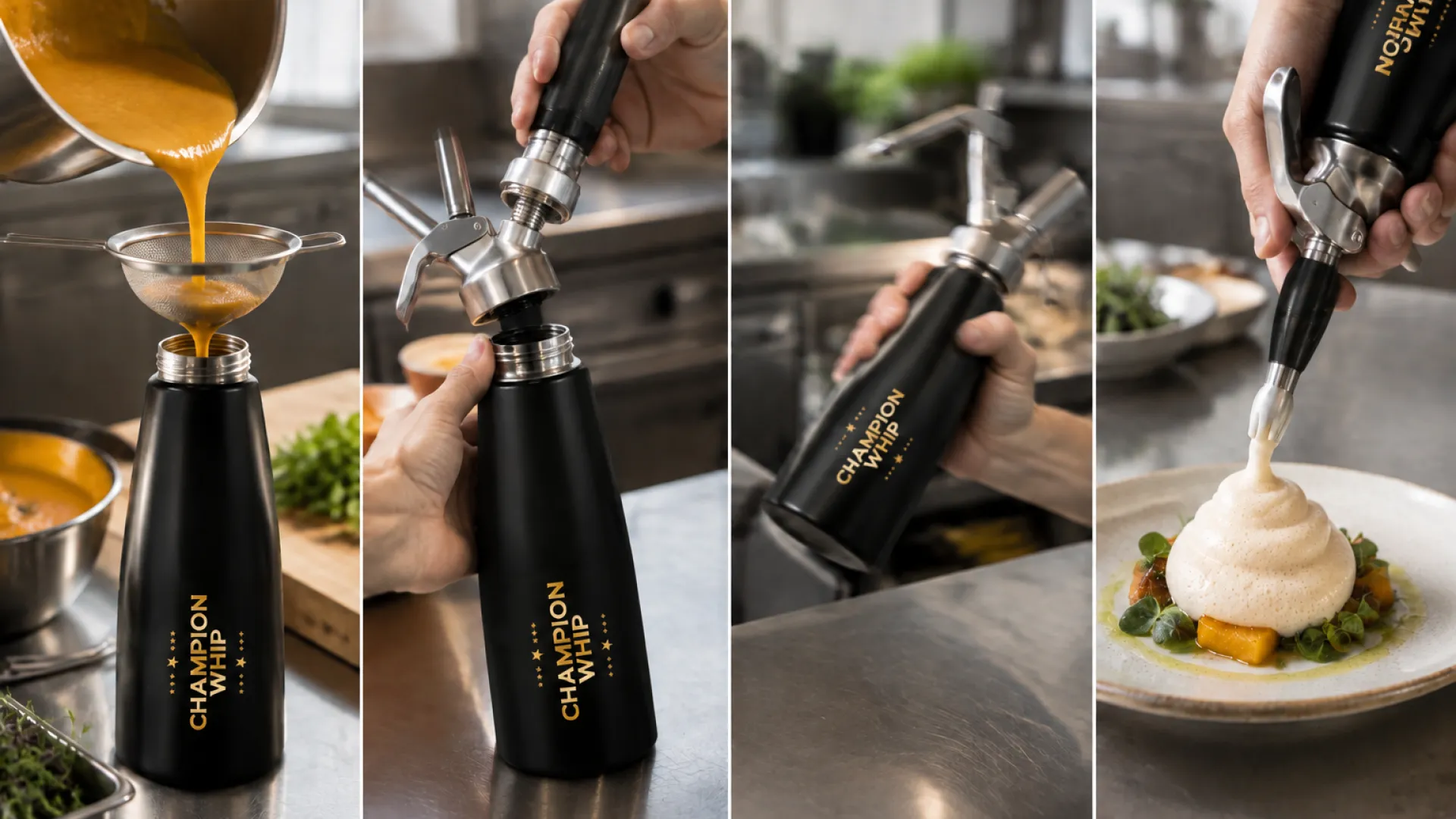
The mechanism has three steps. Under pressure, N2O dissolves into the water and fat of the base. When you pull the lever, the liquid passes the valve and the dissolved gas expands into millions of small bubbles. The viscosity and stabilizers in the base then trap those bubbles, so the foam holds instead of collapsing.
The standard setup is a 0.5L stainless steel cream whipper plus 8g N2O chargers — one charger for thin and cream-based mixes, two for thick purées. A stainless whipper handles both hot and cold preparations and tolerates daily commercial use. Kitchens running espuma through a full service usually move to a 640g cylinder with a pressure regulator, which replaces dozens of loose chargers per day. For a deeper look at the gas side of the process, see how nitrous oxide works in a siphon.
The Base Espuma Ratio Formula
Most espuma failures come from ratios, not technique. Every espuma recipe is the same equation: a base thin enough to pour like heavy cream, enough stabilizer to hold the bubbles, and enough gas to aerate the volume. Use this table as the starting point for a 0.5L siphon.
| Base type (500ml) | Stabilizer | Dose | Chargers | Serve |
|---|---|---|---|---|
| Thin liquid (juice, broth, consommé) | Gelatin or agar | 4–6g gelatin / 1–2g agar | 1 | Cold |
| Fruit purée | Xanthan gum (optional gelatin) | 0.5–1g xanthan (+2g gelatin) | 1 | Cold |
| Cream base (35% fat) | None needed | — | 1 | Cold |
| Egg and dairy base (custard, sabayon) | Optional gelatin | 0–2g | 1–2 | Hot or cold |
| Thick purée (potato, legume) | Gelatin | 2–3g, thin base with stock | 2 | Hot |
Three rules apply to every row. Strain the base through a fine sieve so no particles block the valve. Fill the siphon to the marked fill line, never above it. After charging, shake 10–12 times to distribute the gas, then rest the siphon as the recipe requires before dispensing.
Choosing a Stabilizer: Gelatin, Agar, Xanthan, Lecithin
The stabilizer decides how long the foam lives and what it feels like. Each one has a working range where it performs and a failure mode when overdosed.
- Gelatin is the default for most espumas. It sets softly, melts on the palate, and works in both hot and cold bases. It is not suitable for vegan dishes, and a gelatin-set foam softens again above roughly 35°C.
- Agar agar is the vegan alternative. It sets firmer than gelatin, tolerates heat better, and suits hot espumas. Overdose it and the foam turns brittle and grainy.
- Xanthan gum thickens without heat and keeps thin foams glossy. It works cold, which makes it useful for raw juices. Too much xanthan gives a slick, slimy texture.
- Soy lecithin produces light, air-style foams without a siphon. The hold is weak and the foam fades within minutes, so it suits last-second plating, not service prep.
Hot Espuma vs Cold Espuma
Cold espuma is the easier discipline. Chill the charged siphon for 1–2 hours so the stabilizer sets, then dispense directly onto the plate. A cold espuma holds in the refrigerator for several hours, which makes it practical for prep-ahead service.
Hot espuma runs at 60–70°C. Keep the charged siphon in a water bath at that range or use an insulated whipper, and plan to use the contents within about two hours. Do not re-chill a hot espuma and reheat it later; repeated temperature cycles break the foam structure and create a food safety problem. If a recipe contains egg or dairy, treat the two-hour window as a firm limit.
8 Espuma Recipes: From Potato to Dark Chocolate
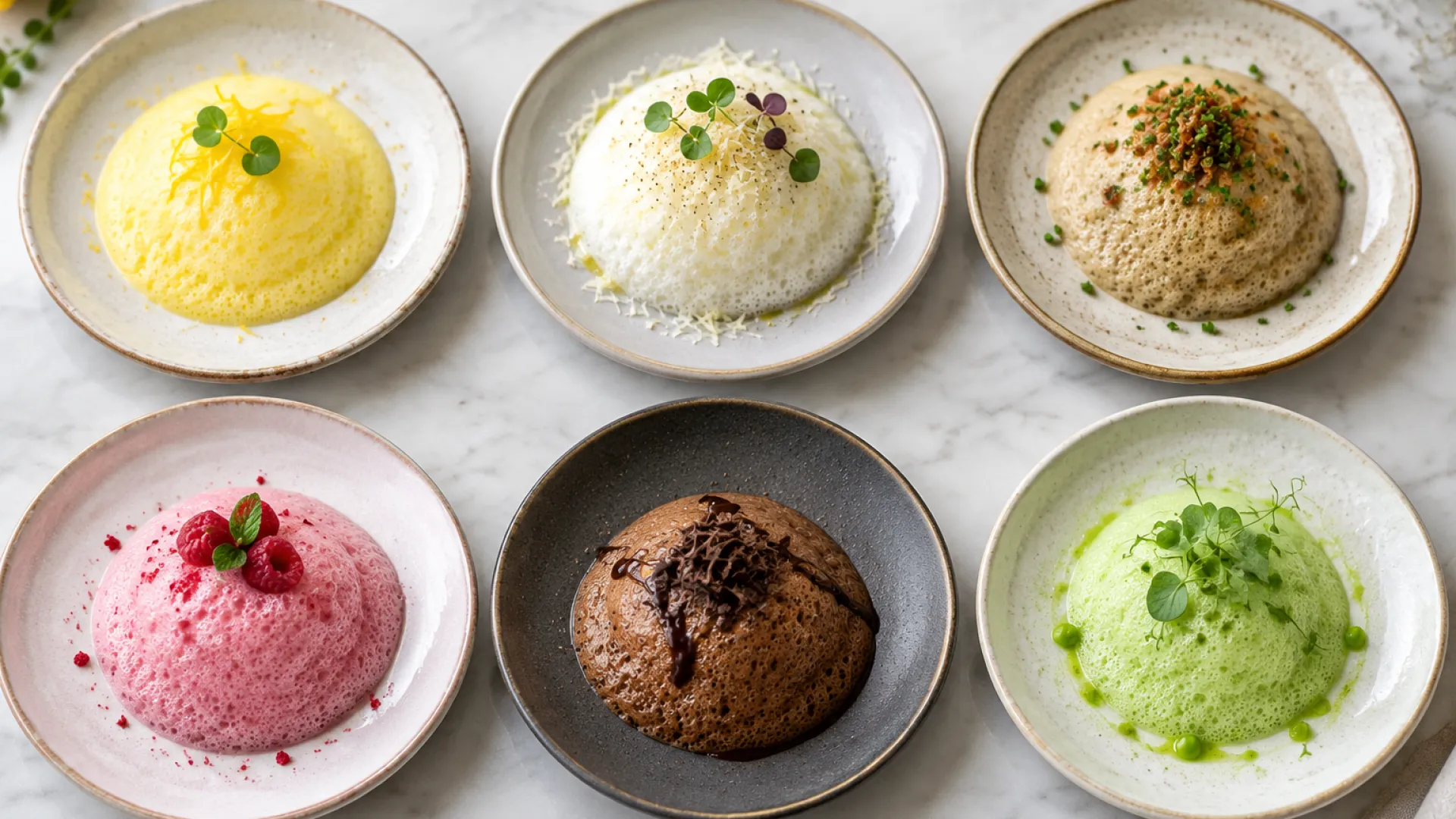
These eight recipes cover the bases most kitchens actually use. Each follows the ratio formula above; quantities are scaled for a 0.5L siphon.
Potato Espuma
The classic hot espuma and the most-searched recipe in this cluster. Simmer 250g peeled potato until soft, then blend with 250ml hot vegetable stock, 50ml cream, and 2g gelatin until completely smooth. Season, strain, fill, charge with two chargers, and hold at 60–70°C. Serve as a base under roasted fish or meat.
Lemon Espuma
A cold, sharp foam for desserts and seafood. Combine 200ml lemon juice with 200ml water and 80g sugar, warm slightly to dissolve, then add 5g gelatin. Strain, chill the base, charge with one charger, and refrigerate for two hours before service.
Parmesan Espuma
A hot savory foam for pasta, risotto, or grilled vegetables. Simmer 300ml milk and 200ml cream with 100g grated parmesan until melted, blend smooth, and season with white pepper. The cheese and cream provide enough body, so no added stabilizer is needed. Charge with one charger and serve warm.
Goat Cheese Espuma
Blend 200g soft goat cheese with 200ml warm cream and a pinch of salt until pourable. Strain, charge with one charger, and serve warm over roasted beets or spread onto crostini. Add 1g gelatin if you need a longer hold on a buffet line.
Dark Chocolate Espuma
Heat 250ml milk with 150ml cream to 85°C, pour over 200g chopped dark chocolate (60–70%), and blend with 2 egg yolks until glossy. Strain, fill, and charge with one charger. Serve warm as a sauce-style foam or chilled for a mousse-like texture.
Yogurt and Cherry Espuma
Drain 300g Greek yogurt overnight. Simmer 200g cherries with 30g sugar, strain the juice, and combine 200ml of the juice with the yogurt and 0.5g xanthan gum. Blend, strain, charge with one charger, and chill two hours. The result is a light breakfast or dessert foam with a clean, acidic finish.
Cocktail Espuma
A foam topper for sours and spritz-style drinks. Mix 200ml of the cocktail's juice or syrup component with 100ml water and 3g gelatin, strain, charge with one charger, and chill. Dispense a cap over the finished drink. Egg white texture without egg white, and consistent foam across a full bar shift.
Seasonal Vegetable Espuma
The template for any vegetable on the menu: 250g cooked vegetable (pea, corn, carrot, beet) blended with 250ml hot light stock and 2g gelatin. Strain, charge with two chargers, and hold warm. Adjust the stock ratio until the base pours like heavy cream — that single check prevents most failures with thick purées.
For a wider set of siphon applications beyond foams — mousses, rapid infusions, and classic whipped cream — see our cream whipper recipe guide.
Can You Make Espuma Without a Siphon?
A true espuma requires a siphon; without one you only get looser foams. A blender with soy lecithin produces a light air that fades within minutes. A milk frother or hand whisk works only on high-fat dairy and gives a coarse, unstable result. Neither matches the fine, lasting structure that pressurized N2O creates, and neither survives on a plate through a dinner service. For occasional home use, workarounds are acceptable; for menu use, the siphon is the method. The same logic applies to dispensers operated without chargers — see what works and what does not when a dispenser has no charger.
Espuma Troubleshooting: Too Runny, Too Dense, Won't Dispense
When an espuma fails, the cause is almost always in this table.
| Symptom | Likely cause | Fix |
|---|---|---|
| Foam comes out runny | Too little stabilizer, or base too thin | Add stabilizer at the low end of the dose range and re-chill |
| Foam too dense, barely aerated | Base too thick, or not enough shaking | Thin the base with liquid; shake 10–12 times after charging |
| Foam weeps liquid after plating | Over-aeration or warm storage of a cold espuma | Use one charger instead of two; hold refrigerated until service |
| Nothing dispenses, siphon blocked | Particles in the base, or purée over the fill line | Depressurize, clean the valve, strain the base finer |
| Grainy or brittle texture | Agar or gelatin overdosed | Cut the stabilizer dose by a third and retest |
Espuma for Commercial Kitchens: Cost per Serving
Espuma earns its place on a menu when the numbers work, and they usually do. A 0.5L siphon batch yields roughly 10–15 plated portions, so the gas cost per serving is one 8g charger divided across the batch. Kitchens that run foams daily feel the difference between loose chargers and a 640g cylinder: one cylinder holds the equivalent of about 80 chargers, which lowers the per-batch gas cost and removes the constant charger swaps during prep.
The bigger saving is labor. A cold espuma can be prepped hours before service and dispensed to order in seconds, with the same texture on the first plate and the last. That consistency is what makes foams practical for cafés, dessert shops, and restaurant lines, well beyond tasting-menu kitchens. For operations scaling up, wholesale cream charger supply in mixed sizes keeps both prep and service covered.
The four variables from the first paragraph — base, stabilizer, gas, temperature — are the whole technique. Get the ratio right, and any liquid in your kitchen becomes a candidate for the siphon.
FAQ
What is espuma in cooking?
Espuma is the Spanish word for foam, used in professional kitchens for siphon-made culinary foams: a flavored liquid or smooth purée loaded into a cream whipper, charged with food-grade nitrous oxide, and dispensed as a fine, stable foam. The technique was developed at elBulli in the 1990s and is now standard in restaurants, cafés, and dessert shops.
Can you make espuma without a siphon?
You can make loose foams without a siphon — a blender with soy lecithin gives a light air, and a milk frother works on high-fat dairy — but neither matches the fine texture and hold of a siphon espuma. For menu use, the siphon with N2O is the reliable method.
How many cream chargers do I need for one batch of espuma?
For a 0.5L siphon, one 8g N2O charger covers thin liquids, fruit purées, and cream bases. Thick purées such as potato need two chargers. Shake 10–12 times after charging to distribute the gas evenly.
What is the difference between espuma and espumita?
Espuma is a siphon-made culinary foam used in savory and dessert cooking. Espumita is the sugar foam beaten into Cuban coffee, made by whipping sugar with the first drops of espresso. The two share a word but no technique or equipment.
Can you make hot espuma?
Yes. Hot espumas run at 60–70°C: keep the charged siphon in a water bath at that range or use an insulated whipper, and use the contents within about two hours. Do not chill and reheat a hot espuma — the foam structure breaks and, with egg or dairy bases, it becomes a food safety issue.
Which stabilizer works best for espuma?
Gelatin is the default: it sets softly, melts on the palate, and works hot or cold. Agar agar is the vegan option and tolerates heat better. Xanthan gum suits cold, thin foams and juices. Soy lecithin makes light airs without a siphon but fades within minutes.
How long does espuma hold in a siphon?
A cold espuma holds for several hours in the refrigerator once the stabilizer has set. A hot espuma should be used within about two hours while held at 60–70°C. Beyond those windows the foam slowly loses volume and begins to weep liquid.
Is nitrous oxide in cream chargers food-safe?
Food-grade nitrous oxide is an approved food additive (E942 in the EU, FDA-recognized in the US) when it meets purity specifications. Source chargers and cylinders from suppliers with documented food-grade certification — 99.95% purity with standards such as FDA, CE, and FSSC 22000 — and keep the documentation in your compliance records.


Elevate Your Creations with
Champion Whip
Explore our premium whipped cream chargers – designed for perfectionists.
View our Products


