

Best Cream Chargers Buying Guide: What Actually Matters in 2026
2026-06-27
If you search "best whipped cream chargers," most results hand you a ranked list of brands — each one sponsored by the brand itself. That's not a buying guide. It's advertising.
This article takes a different approach. We manufacture cream chargers across the full size range (8g through 3000g) and export to distributors in 30+ countries. Instead of telling you which brand to buy, we'll walk you through the criteria that actually separate a reliable charger from a risky one — so you can evaluate any product on the shelf or in a supplier's catalog with confidence.
Three Quality Factors That Define a Cream Charger
N2O Purity: The Spec Most Buyers Overlook
Every cream charger on the market contains nitrous oxide (N2O). The difference is purity. Food-grade N2O comes in three common tiers:
| Purity Grade | Typical Use | What It Means in Practice |
|---|---|---|
| 99.5% | Entry-level food grade | Meets minimum standards; may carry faint metallic taste in sensitive applications |
| 99.9% | Standard food grade | Clean flavor; used by most mid-range and premium brands |
| 99.95% | High-purity food grade | Near-zero residual moisture and oil; best for delicate desserts, espumas, and rapid infusions |
The remaining fraction — that 0.05% to 0.5% — is where problems hide. Residual moisture can cause inconsistent foam. Trace oil leaves a film inside the dispenser. Sulfur compounds create off-flavors that are especially noticeable in neutral or lightly sweetened cream.
How to verify: ask the supplier for a Certificate of Analysis (CoA) from an accredited lab. A CoA lists the actual tested purity, moisture content, and impurity levels per batch. If a supplier can't produce one, that's a signal worth paying attention to.
Cylinder Material and Construction
Cream chargers operate under significant internal pressure — roughly 55–60 bar at room temperature for 8g cartridges, and up to 200 bar for large cylinders. Material quality directly affects safety, shelf life, and contamination risk.
Standard 8g chargers use seamless drawn steel with a crimp seal. High-quality versions add a rust-resistant coating (zinc or chrome) to prevent corrosion during storage. Aluminum-body chargers exist in the market for larger formats; they're lighter but less pressure-resistant than steel at the same wall thickness.
What to check: look for seamless construction (no welds on the pressure body), a clean interior surface free of oil or metal shavings, and a coating that prevents rust. A charger that arrives with visible rust or dents should go straight to the recycling bin — compromised containers are a safety concern.
Certifications: What They Actually Cover
Certification logos appear on nearly every cream charger box. Not all of them mean the same thing.
| Certification | What It Covers | Why It Matters |
|---|---|---|
| FDA (21 CFR 184.1545) | N2O approved as GRAS food-grade propellant (US) | Required for legal food use in the United States |
| CE Marking | Pressure equipment compliance (EU) | Confirms the cylinder meets EU pressure vessel safety requirements |
| E942 Classification | N2O registered as EU food additive | Legal basis for use in food across EU member states |
| FSSC 22000 / ISO 22000 | Food safety management system | Means the entire production line — not just the product — is audited for food safety |
| SGS / TÜV Testing | Third-party product testing | Independent verification of pressure, fill weight, and gas purity |
A logo on the box without a traceable certificate number is marketing. Request the actual document. Serious suppliers provide them proactively — during quoting, not after complaints.
Cream Charger Size Guide: Matching Format to Usage Volume
Cream chargers now come in a wide range of sizes, from the traditional 8g cartridge to 3000g cylinders used in industrial catering. Choosing the wrong format wastes money — either through excessive per-unit cost or through capacity you'll never use.
| Size | N2O Content | Approx. 0.5L Dispenser Loads | Best Fit | Requires Regulator? |
|---|---|---|---|---|
| 8g | 8g | 1 | Home use, low-volume cafés, sampling | No |
| 320g | 320g | ~40 | Small coffee shops, dessert bars | Yes |
| 640g | 640g | ~80 | Mid-volume restaurants, cocktail bars | Yes |
| 2000g | 2000g | ~250 | High-volume kitchens, hotel catering | Yes |
| 3000g | 3000g | ~375 | Industrial operations, large-chain supply | Yes |
The cost-per-gram drops substantially as format size increases. A restaurant using 50+ dispenser loads per week will save 40–60% on gas cost alone by switching from 8g cartridges to 640g or 2000g cylinders. The tradeoff: larger cylinders require a pressure regulator to step internal pressure (up to 200 bar) down to the dispenser's rated 10–12 bar working range.
For home users and low-volume operators, 8g chargers remain the simplest option — no accessories needed, universal dispenser compatibility, and near-zero learning curve.
How to Evaluate a Cream Charger Brand
We're deliberately not ranking brands here. Any ranking from a manufacturer would be biased. Instead, here's a practical framework you can apply to any brand you encounter.
Origin and manufacturing transparency. Does the brand disclose where its chargers are produced? A company that owns its filling lines can control gas purity, fill weight accuracy, and cylinder quality. Brands that outsource production to contract fillers have less direct oversight — which isn't necessarily bad, but it means the brand's quality claims depend on a third party's execution.
Documentation on request. Can they provide a CoA for N2O purity? A pressure test report for the cylinder? A food-contact material certificate for the steel? These documents should be available before you commit to a purchase order — not hidden behind excuses.
Fill weight consistency. A quality 8g charger should contain 8.0g of N2O per unit, not 7.5g or 7.8g. Variation comes from production line calibration. If a batch of chargers gives you inconsistent whipped cream from the same recipe, fill weight drift is often the cause. Premium manufacturers like iSi electronically weigh each cartridge; others rely on batch sampling.
Seal integrity. The foil seal at the tip must puncture cleanly when the dispenser pin engages. Poorly sealed foils leak gas before the dispenser is fully charged, resulting in weak foam output. A batch of "duds" is usually a seal issue, not a gas issue.
Apply these four checks to any brand — from a well-known European name to a private-label product on a wholesale platform — and you'll get a clearer picture than any review site can give you.
B2B Wholesale vs. Retail: Different Needs, Different Priorities
Buying cream chargers as a business is fundamentally different from buying them as a home cook. The table below lays out the key differences.
| Factor | Retail / Home Buyer | B2B / Wholesale Buyer |
|---|---|---|
| Typical format | 8g cartridges (packs of 10–50) | 640g–3000g cylinders; 8g in case lots (600+) |
| Purchase volume | 10–100 units/month | 1,000–50,000+ units/month or equivalent in cylinders |
| Priority | Convenience, dispenser compatibility | Cost per gram, documentation, supply consistency |
| Certification needs | Food-grade label is sufficient | Full compliance pack: CoA, CE/FDA, MSDS, customs classification |
| Pricing model | Fixed retail price | Tiered pricing based on MOQ; FOB/CIF terms |
| Supplier relationship | One-off purchase | Ongoing partnership with sample approval, quality agreements |
If you're sourcing for a restaurant, café chain, or distribution business, the initial sample order matters more than the quoted price. Run the sample through your actual production workflow: charge a dispenser, check foam quality, verify fill weight on a kitchen scale, and store the product for a few weeks to confirm shelf stability. That ten-minute test saves you from a container load of problems.
For wholesale inquiries, we maintain a dedicated wholesale page with MOQ details, available formats, and logistics options.
Five Common Buying Mistakes
Buying on price alone. The cheapest charger per unit often has the highest hidden cost — inconsistent fills, failed seals, missing documentation that holds up customs clearance. A few cents saved per charger can translate into thousands in wasted cream and delayed shipments.
Ignoring the regulator requirement. Connecting a 640g+ cylinder directly to a dispenser rated for 10–12 bar is dangerous. Large cylinders contain gas at up to 200 bar and require a pressure regulator between the cylinder and the dispenser. This is non-negotiable for safety.
Assuming all "food grade" labels are equal. "Food grade" is a broad category. A 99.5% purity charger and a 99.95% purity charger both technically qualify as food grade, but the performance gap is real — especially for applications where off-flavors are detectable, like plain whipped cream or cold foam for specialty coffee.
Not checking dispenser compatibility. Standard 8g cartridges use a universal thread that fits virtually all dispensers. Larger cylinders use brand-specific valve types and require matching regulators. Before ordering a case, confirm that the cylinder's valve standard matches your equipment.
Skipping the sample stage. Even for reorders from an existing supplier, quality can shift between production runs. A quick check of a few units from each new shipment catches problems before they reach your kitchen or your customers.
Ready to Source?
Whether you're outfitting a single café or stocking a distribution warehouse, the fundamentals are the same: verify purity, check certifications, match the format to your volume, and test before you commit.
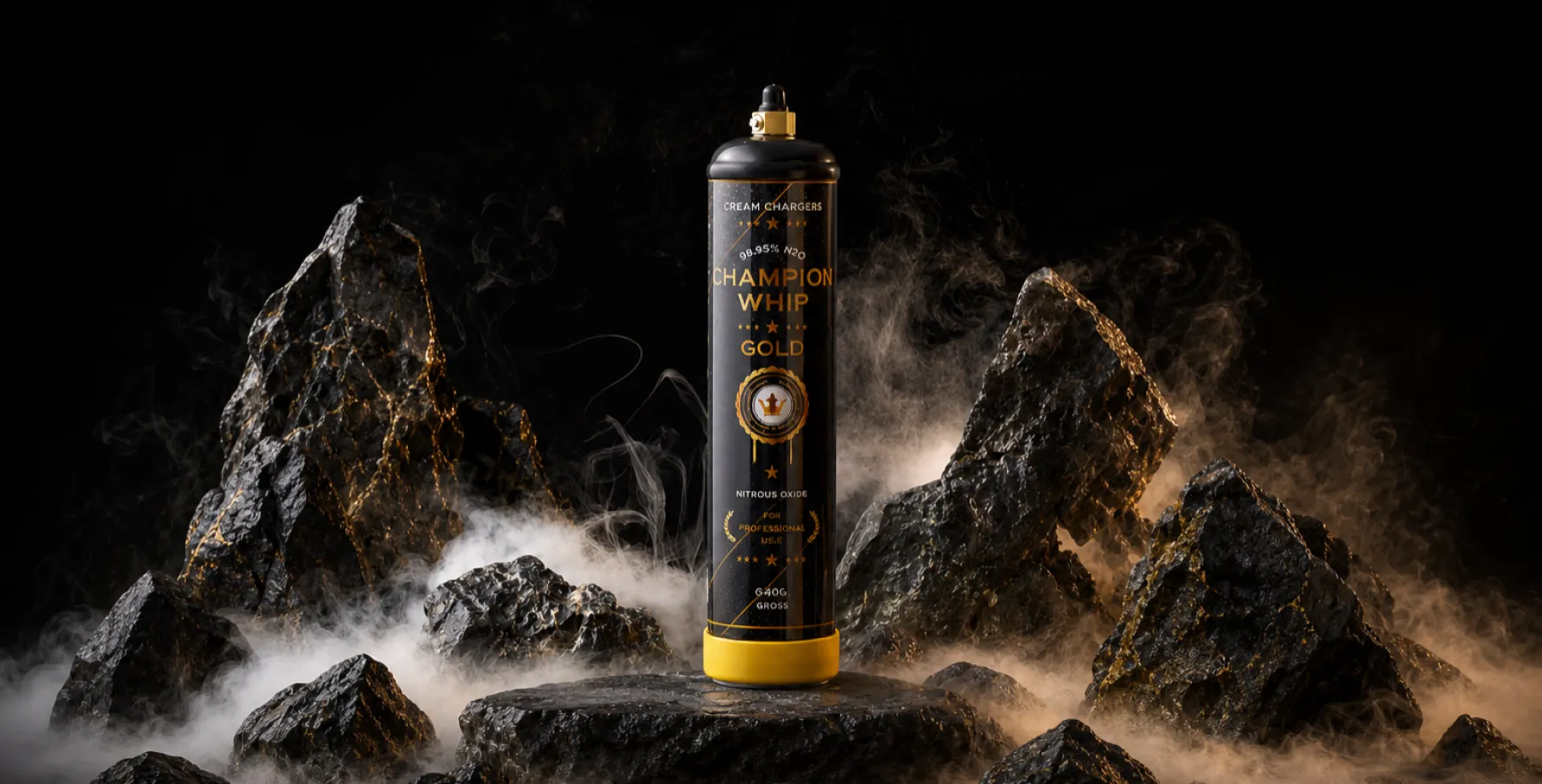
Champion Whip manufactures cream chargers across the full size range — from 8g cartridges to 3000g cylinders — with 99.95% N2O purity and factory-direct pricing. We provide full documentation (CoA, FDA, CE, FSSC 22000) with every order and offer OEM customization for brands building their own product line.
Browse our product catalog, request a wholesale quote, or contact our team directly.
FAQ
What purity level of N2O should I look for in a cream charger?
For most culinary applications, 99.9% purity is the baseline for clean flavor and consistent foam. If you work with delicate preparations like espumas, cold foam, or rapid infusions where off-flavors are easily noticed, 99.95% purity provides better results. Always request a Certificate of Analysis from your supplier to confirm the actual tested purity — not just a label claim.
What is the difference between an 8g charger and a 640g cylinder?
An 8g charger is a single-use cartridge that charges one 0.5L dispenser load. It requires no accessories and fits standard dispensers with a universal thread. A 640g cylinder holds the equivalent of roughly 80 individual 8g chargers and connects to a dispenser through a pressure regulator. The cylinder format reduces per-gram gas cost by 40–60% and eliminates constant cartridge changes during busy service, making it the standard choice for commercial kitchens.
Do I need a pressure regulator for large cream charger cylinders?
Yes, a pressure regulator is required for any cylinder 320g or larger. These cylinders store N2O at up to 200 bar of internal pressure, while cream dispensers are only rated for 10–12 bar. The regulator steps the pressure down to a safe working range. Connecting a large cylinder directly to a dispenser without a regulator can damage the dispenser and creates a genuine safety hazard.
How can I verify if a cream charger is genuinely food-grade?
Ask the supplier for three documents: a Certificate of Analysis (CoA) showing tested N2O purity and impurity levels from an accredited lab, a food-contact material certificate for the cylinder steel, and regulatory certification for your market — FDA registration for the US, CE marking and E942 classification for the EU. If a supplier cannot provide these on request, treat it as a red flag regardless of what their packaging says.
How many dispenser loads does each charger size produce?
A standard 8g charger produces one 0.5L dispenser load of whipped cream. A 320g cylinder provides approximately 40 loads, a 640g cylinder around 80, a 2000g cylinder roughly 250, and a 3000g cylinder approximately 375. Actual output varies slightly depending on cream fat content, desired texture, and dispenser condition.
What certifications should a cream charger have for commercial use?
For commercial use in the US, the N2O should comply with FDA 21 CFR 184.1545 (GRAS status as a food-grade propellant). In the EU, E942 classification and CE marking for the pressure vessel are required. FSSC 22000 or ISO 22000 certification on the production facility adds a layer of assurance that the entire manufacturing process — not just the finished product — meets food safety standards. SGS or TÜV test reports provide independent third-party verification of fill weight and pressure specifications.
How should I store cream chargers to maintain quality?
Store cream chargers in a cool, dry location below 50°C (122°F), away from direct sunlight, heat sources, and open flames. Keep them upright in original packaging. Under proper storage conditions, sealed 8g chargers have a shelf life of 3–5 years. Opened large cylinders should have the valve closed after each use and be stored upright; they maintain pressure with no significant loss between uses when kept at stable room temperature.

Elevate Your Creations with
Champion Whip
Explore our premium whipped cream chargers – designed for perfectionists.
View our Products


